FR. JIM KAPTEIN
ST. BRIEUX PARISH, ST. BRIEUX, SK
AUGUST, 1999 TO JULY, 2004
Introduction
No one can have greater love than to lay down one’s life for their friends. (John 15:13)
“Let us now sing the praises of our ancestors in their generations. Some of them have left behind a name, so that others declare their praise. These were godly people, whose righteous deeds have not been forgotten; their wealth will remain with their descendants, and their inheritance with their children’s children.” (Sirach 44:8-10)
This church in St. Brieux is a testimony to those who have come before us. The most valuable asset the first pioneers brought with them was their faith in God. Their first priority was to build a church where they could come together and praise the God who gave them life and freedom. The church in St. Brieux has undergone many changes since those early days, but the faith has remained strong. This booklet is a legacy of their efforts, and as St. Brieux celebrates its 100th anniversary in 2004, we hope this booklet will continue their efforts in passing the faith onto the next generation.
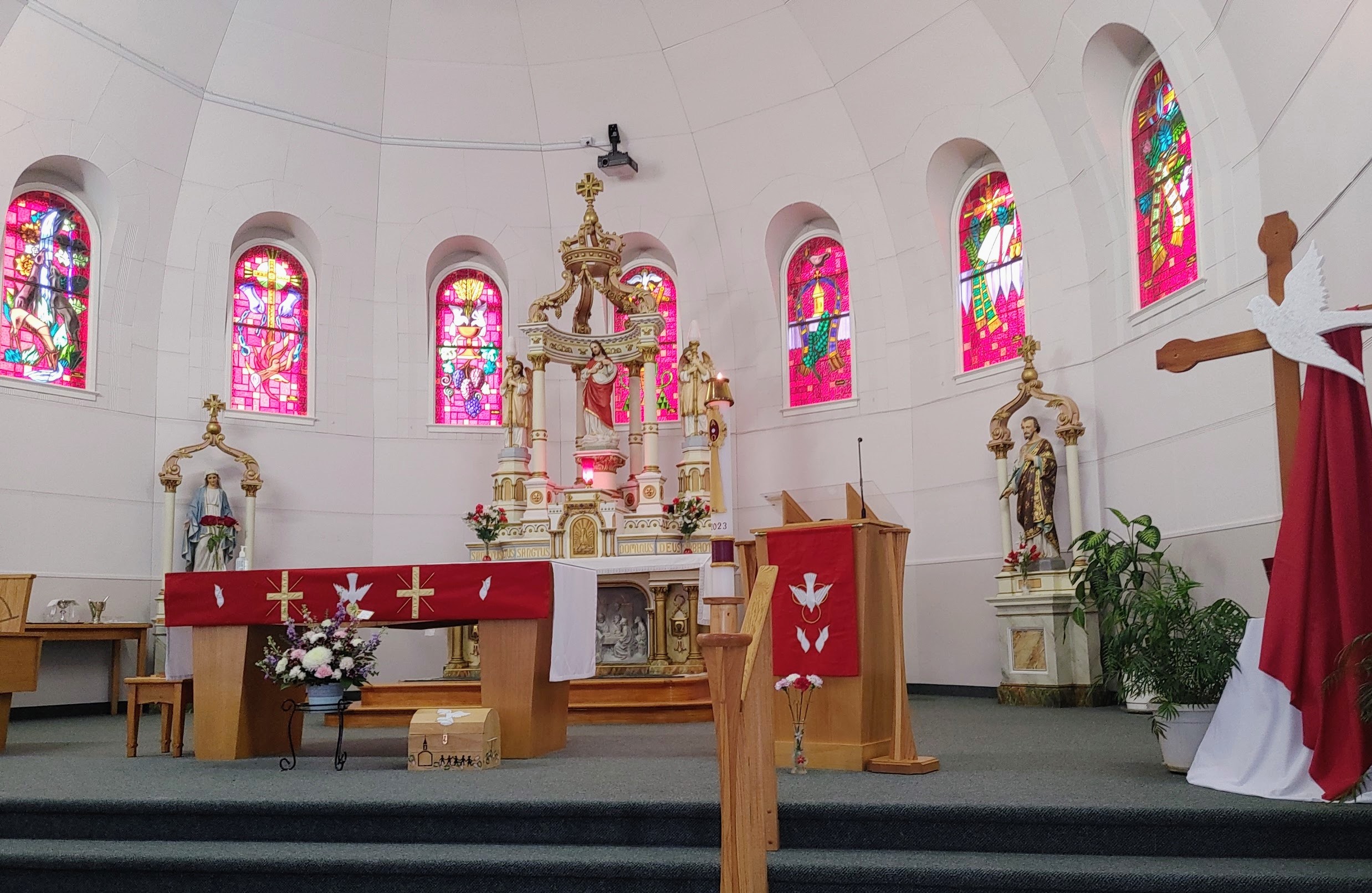
Every generation has its own way of celebrating their faith in God. However, if we are not careful we will lose the meaning of how those celebrations were manifested. The words Sanctus Sanctus Sanctus Dominus Deus Sabaoth are in Latin words meaning Holy, Holy, Holy, Lord God of Hosts. If this wisdom is not passed onto the next generation those words will just become meaningless. In the days before catechism programs, the stories of our faith were written on walls and windows of the churches and cathedrals around the world.
Over the years these stories of faith have been written on the walls and windows of the Church in St. Brieux. We hope you will enjoy reading about the symbolism that is present in this church. And we hope that you will continue in the tradition of our pioneers, and pass those stories onto the next generation.
May Almighty God bless you and keep you. May his face shine upon you, and be gracious to you. May he look upon you with kindness, and give you his peace. (Numbers 6:24-25)
A Short History of St. Brieux Parish from (the diocesan history book) The Kaleiscope
The first settlers came to St. Brieux from Brittany, France (The place where our patron spent much of his life). They sailed from St. Malo on the S.S. Malou on Friday, April 1, 1904, Good Friday of that year. Upon arriving in Prince Albert they were met by Fr. Maisonveuve who guided them to the St. Brieux area.
After the small initial church, a second church, the present church, was completed under the watchful eye of Fr. Barbier in 1918, and was blessed on July 27, 1919. Fr. Barbier also convinced the Daughters of Providence to come and establish a community. In 1934 Fr. Rivard would come to St. Brieux and stay until 1974. It would be under his tutelage in the early 1960’s that the rectory on the West side of the church would be built. In 1950, the east and west wings of the church would be added, along with the present sanctuary. In 1988-89 extensive renovations would be done to the roof, and foundation. The final renovations, completed in 2002, would connect the church to the rectory, giving us washrooms, running water, meeting areas, a proper sacristy and social area. With these final renovations we stand on the shoulders of all who helped build the parish here in St. Brieux, and we can look to the future with hope. The following pages are a description of some of the items found in the church.
Saint-Brieuc in Brittany (Our namesake)
Saint Brieuc is situated on a plateau between the Gouëëdic River and the canalized Gouëët River on the north coast of Brittany. It is located barely 2 miles from Saint-Brieuc Bay on the English Channel. The town sits astride Route National N 12, at its intersection with D 700. It is 80 miles east of Brest, 48 miles southwest of Saint-Malo, 57 miles northwest of Rennes and 235 miles west of Paris. It is the capital of the Département of Côtes-d’Armor [Côtes-du-Nord].
Saint-Brieuc was named after the 5th century Welsh monk, St. Briocus, who evangelized the area. The town grew up about the monastery he established. St. Brieuc (Breton for the old English Biocus), founded his monastery there after arriving as a refugee from the Norsemen invasions of Britain in the fifth century. The fifteenth century Fontaine de Saint Brieuc marks the spot where St. Brieuc had settled. Nearby, the current Cathéédrale St-Etienne was first constructed in the thirteenth and fourteenth century to house the early relics of St. Brieuc.
During the “Hundred Years” War, 1337 to 1453, the English besieged the town. In 1375, Olivier de Clisson defended the town against the duke of Brittany. However, in 1394, Clisson himself attacked the town. In 1592, during the Wars of Religion, the Spaniards pillaged the town and it was struck by the plague in 1601.
The Cathédral de Saint-Étienne was constructed over the course of two hundred years, from the 13th to the 15th century, as a church fortress. The seven bays of the lofty nave were rebuilt in the 18th century. The wooden altar, in the south aisle, was carved by Corlay around 1745. The southern transept is lighted by beautiful 15th century stained glass windows. The cathedral was restored in the 19th century. To its north are many 15th and 16th century half-timbered and corbeled houses.
Saint-Brieuc is an important northern Brittany market town and tourism center. Its port is engaged in outfitting vessels for the Newfoundland and Iceland fishing fleets. The town’s products include brushes and metallurgy. A national school of navigation is located in the town.
The Stain Glass Windows
The Large Round Window in the Bell Tower
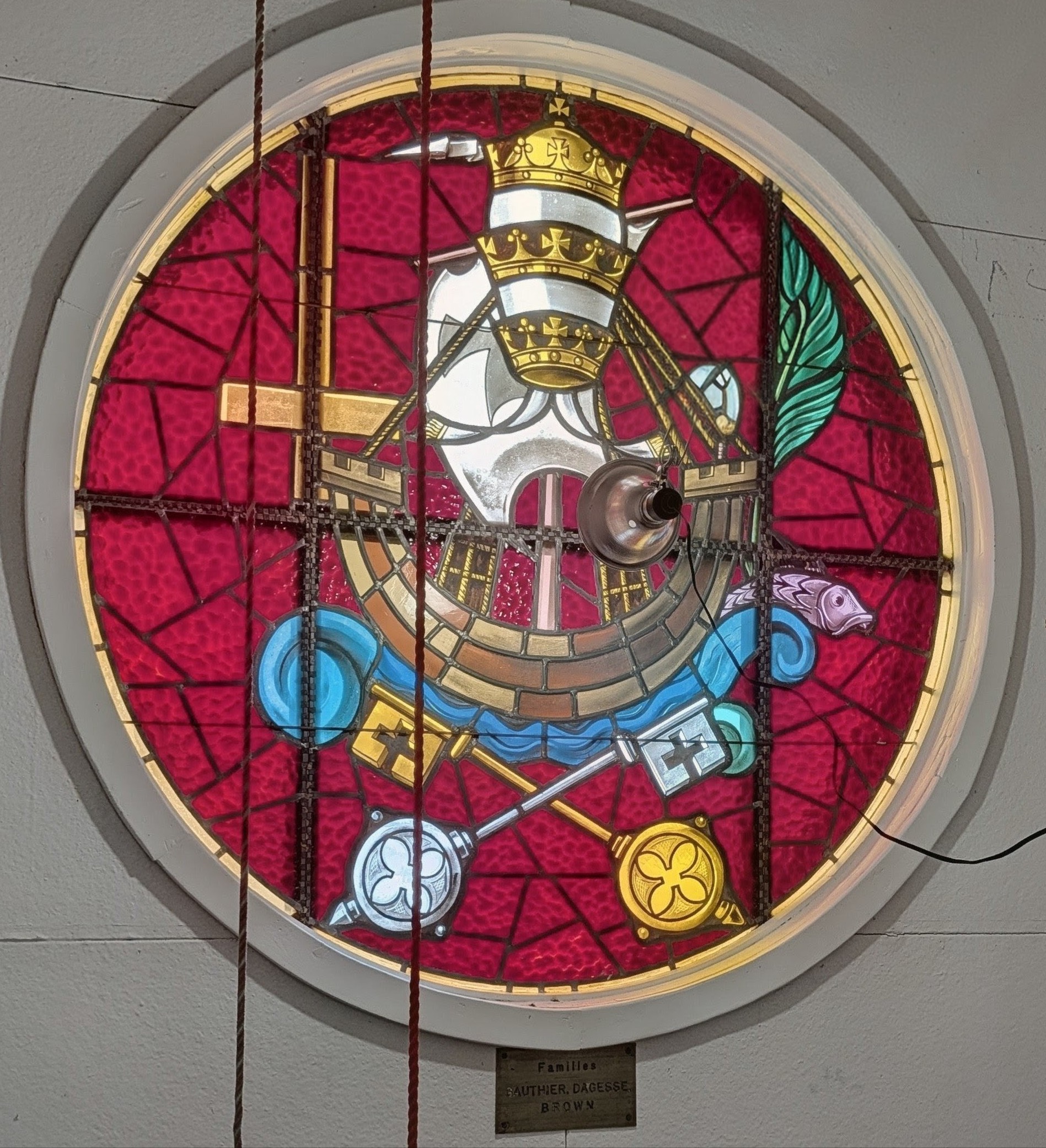
This window has been used as a basis for our parish logo. There are many elements of the Catholic Church built into the design. The Papal Tiara, a development of the medieval papacy. The three tiered Tiara has many interpretations. One interpretation sees the Universal Pontiff as serving the Church militant, suffering and triumphant. Another interpretation sees in the first circlet a symbol of the pope’s universal episcopate, the second his primacy of jurisdiction and the third, his temporal influence. The Tiara is no longer used by the Popes, since Pope Paul VI sold the one that had been made for his inauguration as Pope. The Boat, is a symbol of the ark of Peter, the Church. Very often the Church has been compared to a boat which sets out on the seas of life. The journey is at times very turbulent and at times very serene. In the Old Testament, Noah escaped in a boat. The world was saved through his action and submission to God. There is also a lamp on the boat, symbolizing how Jesus Christ is the light of the world, and how he guides the Church. The Sails: represent the power that moves the Church. The sails are full with wind. The breath of life; the wind a sign of the Spirit of God who guides and energizes the Church. The movement of the Church is totally dependent of the Spirit of God. The Blue: is water, the sea which represents life. The Ocean in the Old Testament was a symbol of chaos, Jesus’s calming of the storm was his power of chaos. Because the Middle East is so arid, water is also a symbol of life and hope, hence its connection with baptism. The Keys: Jesus gave to Peter to represent keys of the kingdom, which he left his followers to bind and unbind. (I give you the keys of the kingdom of heaven; whatever you bind of earth will be bound in heaven Mt. 16:19). The gold and silver of the keys represents this double responsibility. The keys are a symbol of the authority given by Christ, to Peter and his successors. The Cross, notice it is upside down, is a strong symbol of our faith. It is where Jesus gave his life for our salvation. Tradition has St. Peter asking to be crucified upside down, because he did not deem himself worthy to be crucified in the same manner as Jesus. The Fish: is the ancient Christian symbol for our Savior. The Greek work for fish is ichthus. I-CH-TH-U-S forms an acrostic from the initial letters of Iseous CHristos THeo Uios Soter. Which is translated to Jesus Christ, Son of God, Savior. The fish is also connected to the catch of fish described in John 21:4-14 and is therefore emblematic of the vocation of the Apostles “Fishers of Men.” The Palm: connects the mission of the Church to the mystery of Holy Week when Christ was welcomed into Jerusalem. The Paschal mystery is at the heart of the mystery of the Church. The Red Background: is a symbol of the Spirit of God. The Spirit of God hovered over all creation and fills the world. The Church’s mission is to reveal to all the loving mystery of God who wants to relate to us.
Three Crescent-Shaped Windows
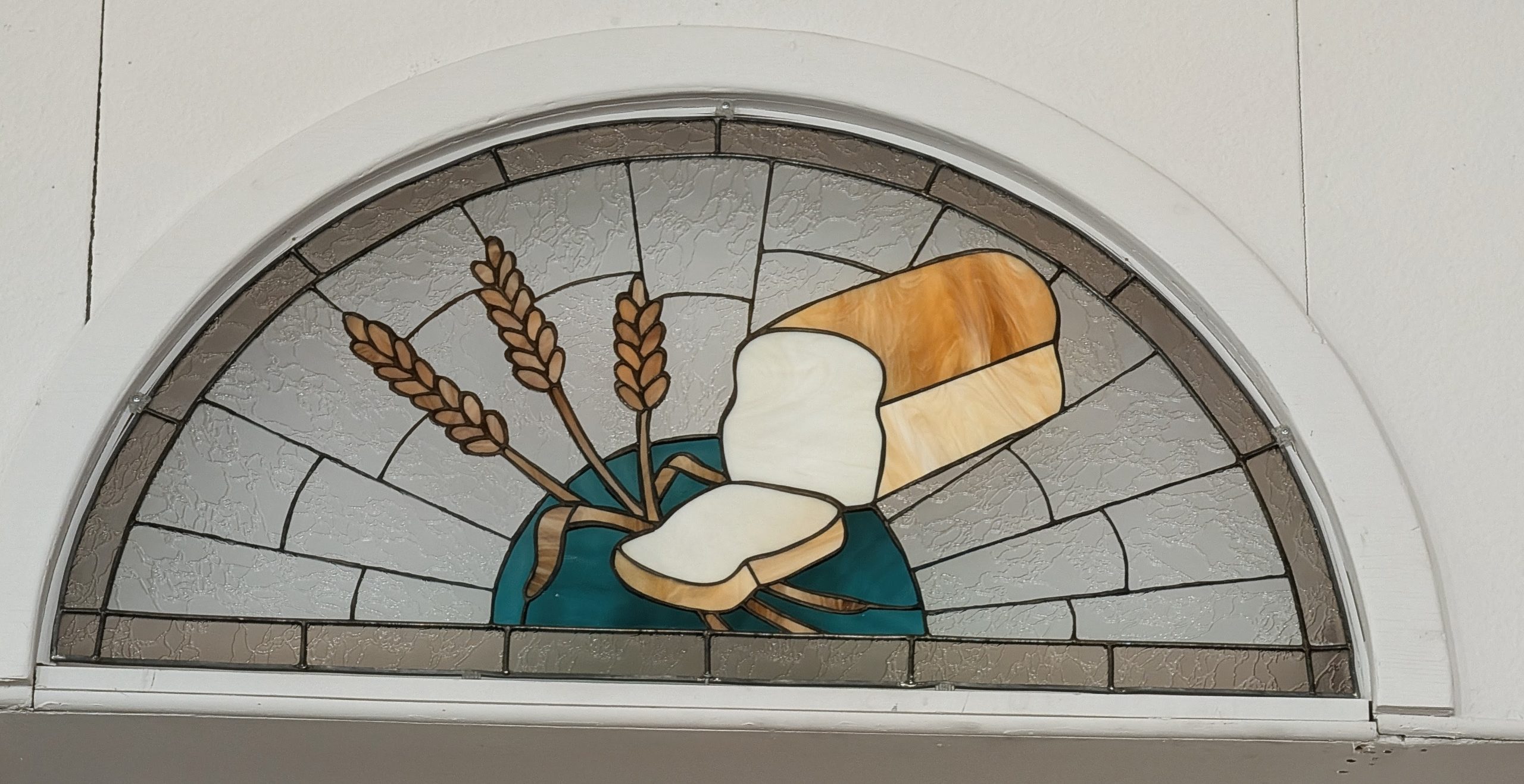
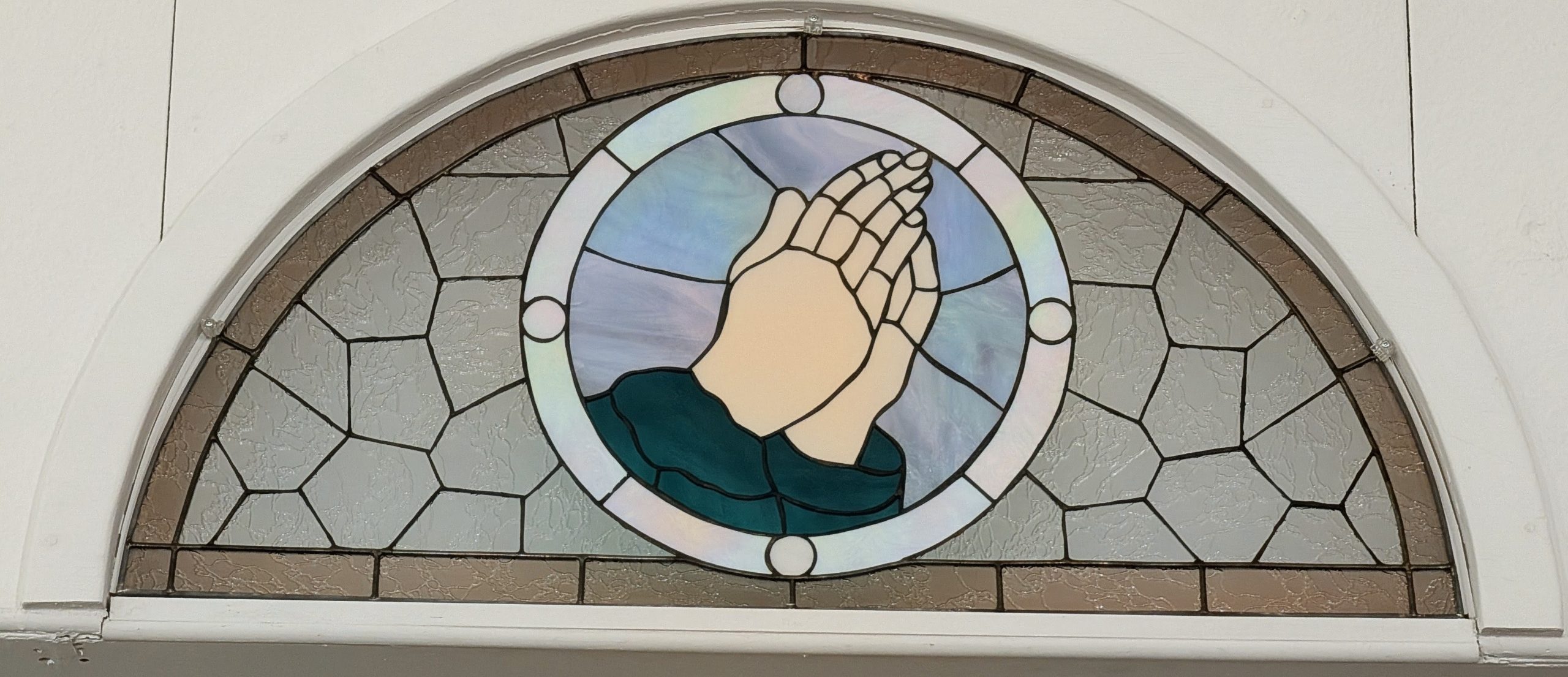
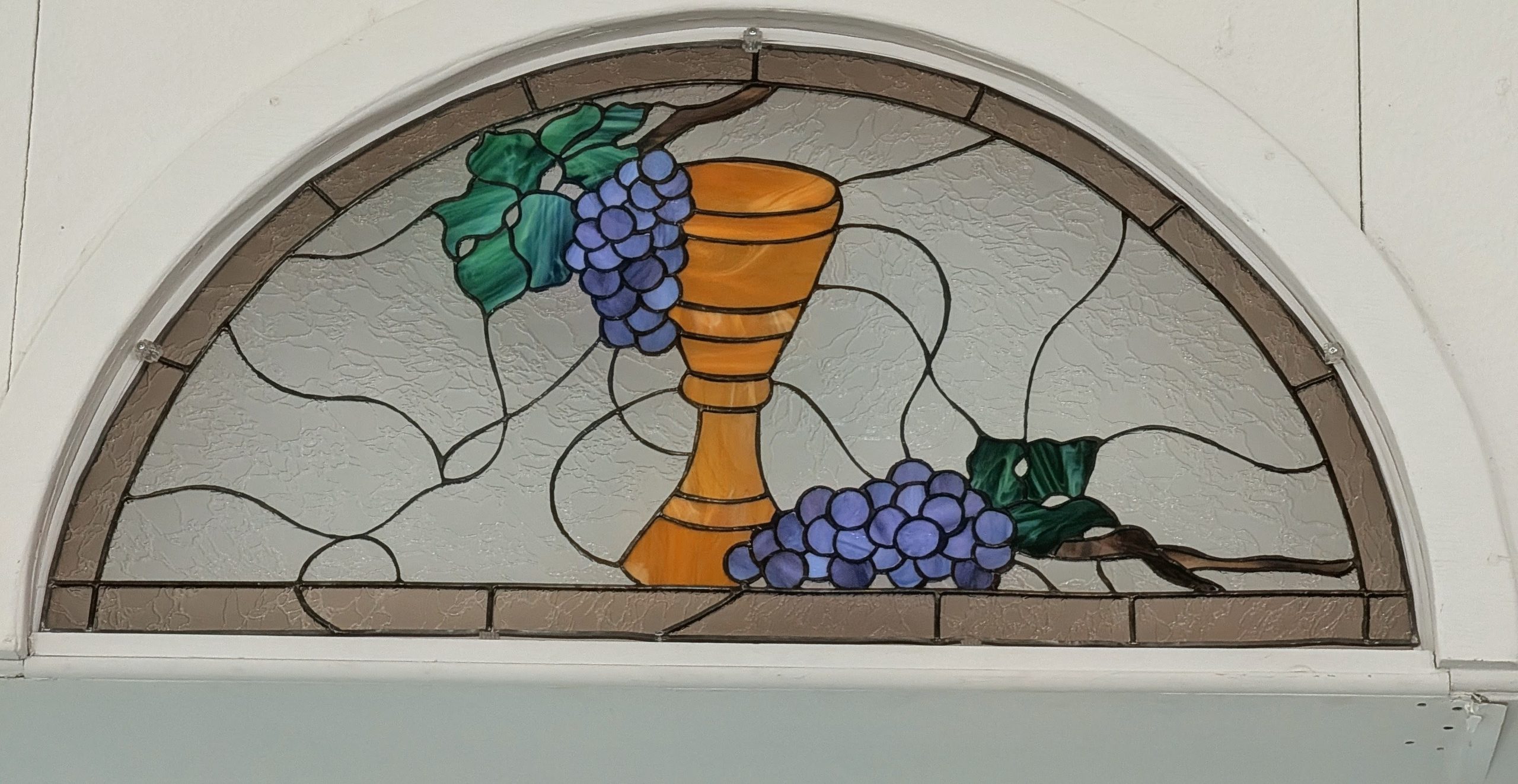
Three crescent-shaped windows have been placed in the holes left by the 2002 renovations. These three windows must be seen as a unit. The two outside windows with the grapes and cup, and wheat and bread are a direct reference to the Eucharist which is the central focal point of our faith. The two hands in prayer, found in the middle, remind us that everything we do must come out of our worship and our prayer. Green is the color of life, and is present in all three windows; reminding us that it is through the Eucharist and through our prayer that we receive life.
The Seven windows in the Sanctuary
There are seven stain glass windows surrounding the sanctuary. From left to right they represent the seven sacraments:
Baptism
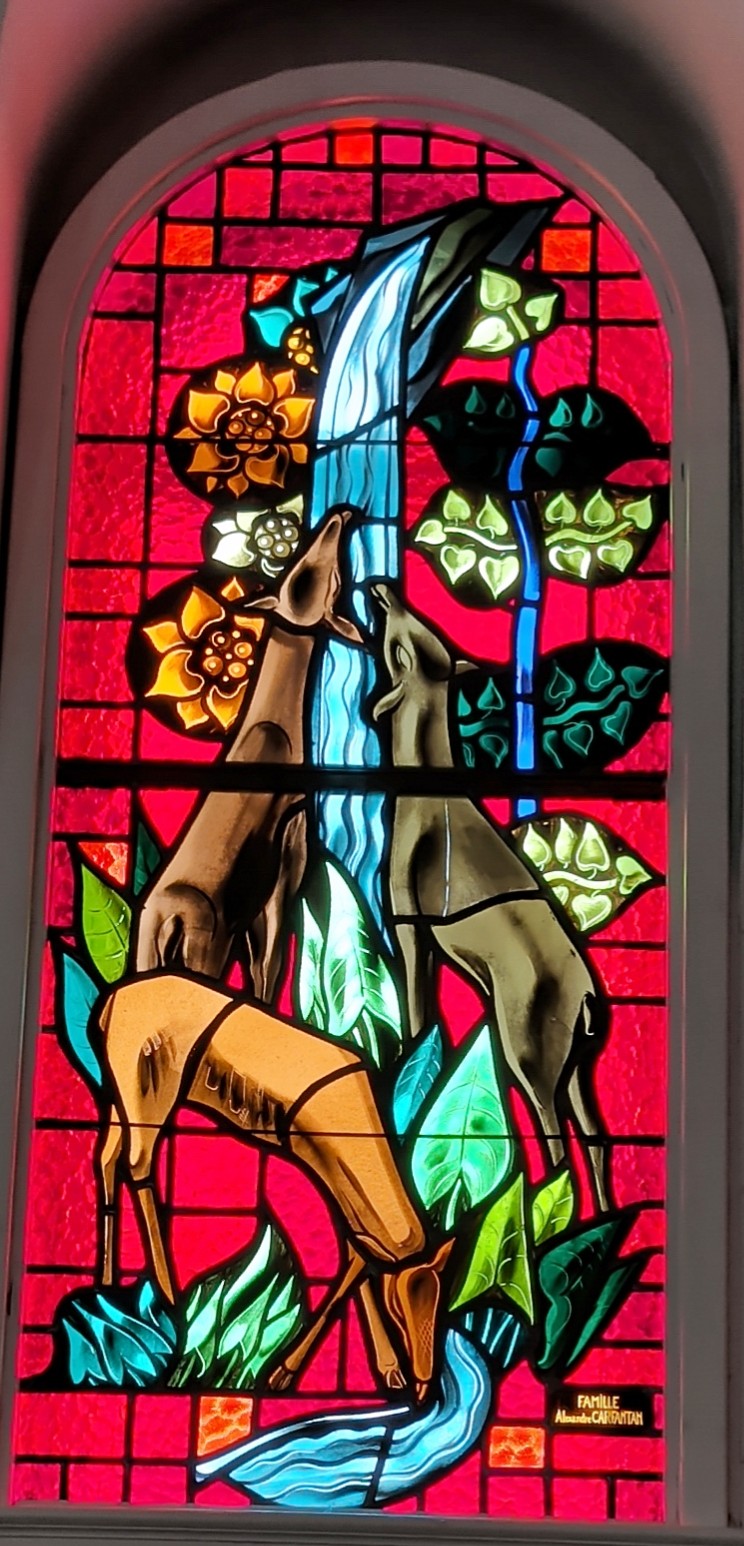
The main feature of this window is a waterfall. A reminder of the living water that one receives upon baptism. Prominent in the window are also three deer, drinking deeply from the water of new life. These deer are reminiscent of Psalm 42 “Like BAPTISM a deer that longs for running streams, so my soul longs for you my God.” (Ps. 42:1). Interspersed within the window are a number of flowers and green leaves, which indicate the life which water gives to all living things.
Reconciliation
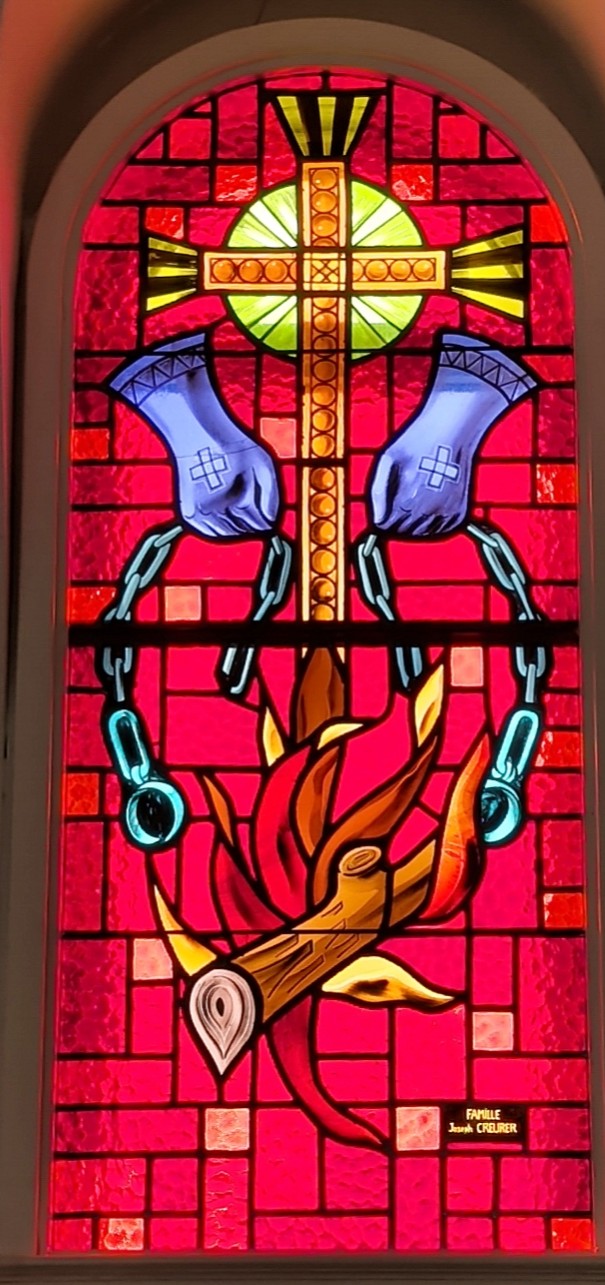
The most prominent feature in this window are the broken chains. On the cross (which is in the background) Jesus broke the chains of sin, and whenever we celebrate this sacrament we are free from the chains of our sin. Accompanying the chains are a pair of hands with a cross on the back of each. They are the hands, and wounds of Jesus, that are needed to break the chains of sin. The hands are purple, as purple is a penitential color, worn by the priests to celebrate Reconciliation. There is a log at the bottom of the window as a reminder that we must take the log out of our own eye before we can take the speck out of our neighbors eye. (Lk 6:41). The log is on fire as we are reminded that our sin is burned out of us by the power of the Holy Spirit.
Eucharist
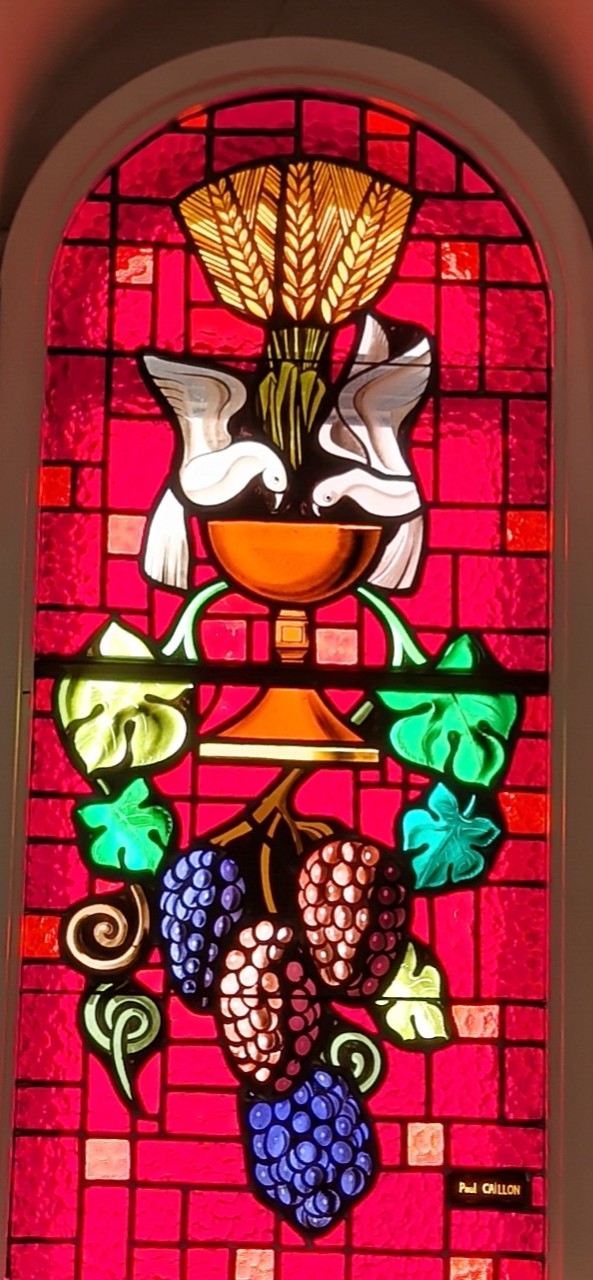
This window is filled with symbols of the Eucharist. The small sheaf of wheat, from which the flour for the Eucharistic bread is made. The grapes and grape leaves from which the wine is made, the chalice which is used in the sacrifice of the mass. The doves are a traditional symbol of the Holy Spirit, which is called down to change the bread and wine into the Body and Blood of Jesus.
Confirmation
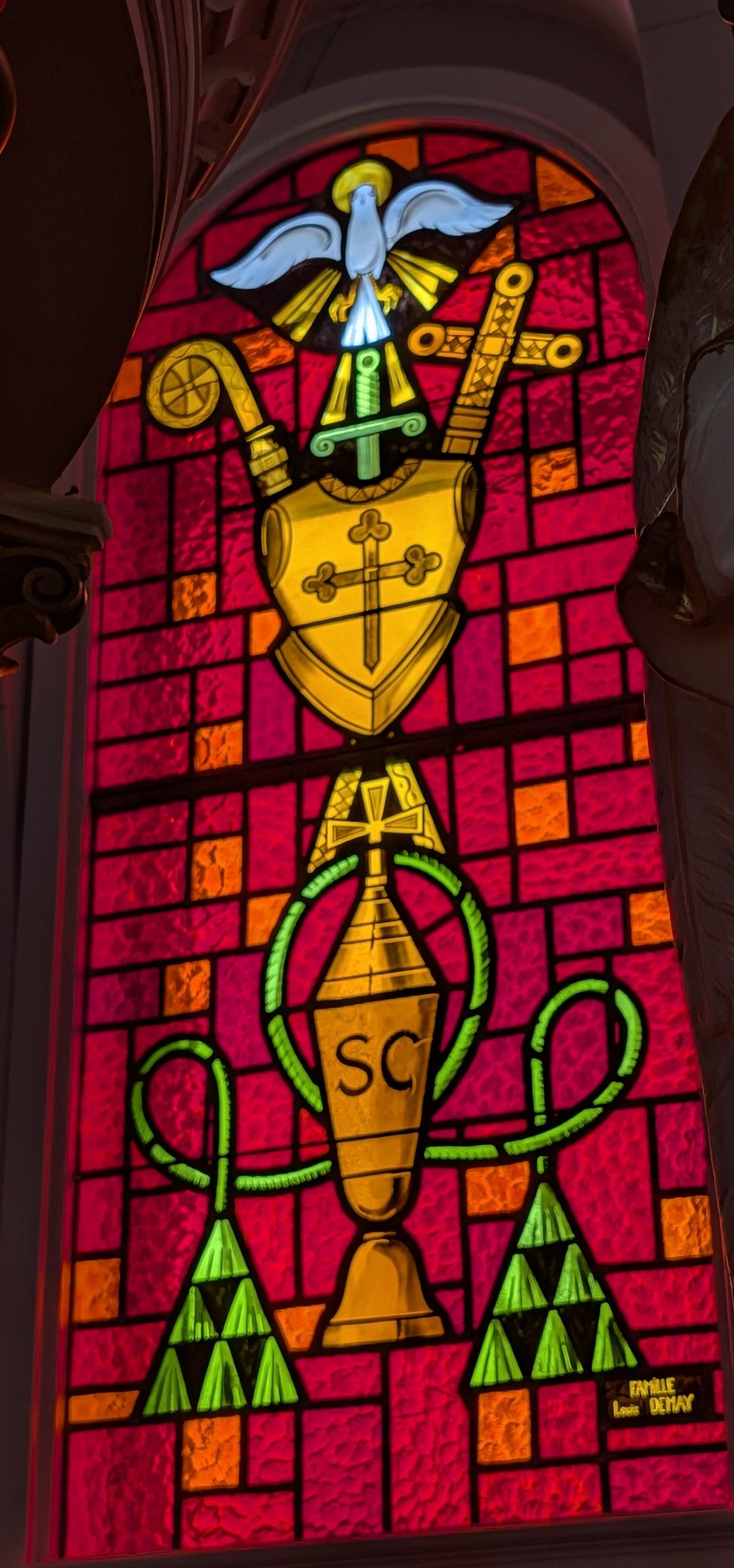
The are two prominent features in this window. The first is the oil container with the letters SC stamped on it. This is the sacred chrism, the oil which is used to seal each of the confirmands with the gift of the Holy Spirit (indicated by the presence of a dove in the window). The second feature is the breastplate and sword. These are reminiscent of the words of St. Paul in his letter to the Ephesians, as they prepare to do spiritual battle. “Stand your ground with truth buckled around your waist, and integrity for a breastplate.. and receive the word of God from the spirit to use as a sword.” (Ep. 6:14-17). Behind the breastplate is the bishop’s crosier, which is the staff the bishop uses to shepherd his people. It is a sign that upon confirmation, we have completed our initiation into the church, and are ready to take our place as one who helps our bishop in his mission of spreading the good news. The last item behind the breastplate is a processional cross. This dates the windows. In the past, a second processional cross immediately preceded the bishop to remind him that there is suffering in our journey. At the bottom of the window is a green Cincture. Note that there are three tiers to the tassels. Once again a symbol of a bishop. A deacon was entitled to wear a tassel with one tier, a priest had two tiers, and a bishop with a green three tiered cincture.
Anointing of the Sick
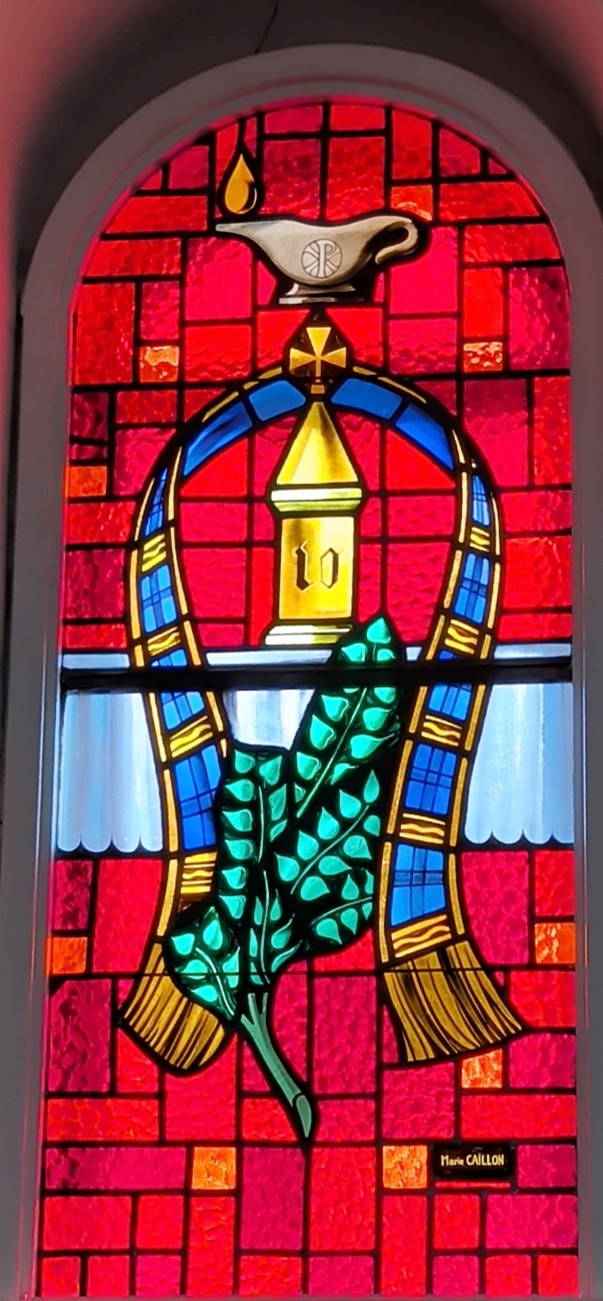
This sacrament is often incorrectly referred to as Extreme Unction. In years past it was celebrated as a sort of rite of passage from this life to the next. But the sacrament, all sacraments, are for the living not the dead. The purpose of the sacrament is to heal the body and soul. We are commanded by James in his letter “If one of you is ill, they should send for the elders of the church, and they must anoint them with oil in the name of the Lord and pray over them. The prayer of faith will save the sick one and the Lord will raise them up again; and if they have committed any sins, their sins will be forgiven.” (James 5:14-15). Centered in the window is the oil container with the letters OI or oil of the infirmed. Oil of the infirmed is the oil that is blessed by the bishop at the Chrism Mass specifically for use in the Sacrament of the Sick. Olive branches are also present indicating where the oil originated. The priest’s stole is once again present reminding us of his role in this sacrament. On the top of the window is an oil lamp, reminding us of the light of Christ. Inscribed on this lamp is the Pax symbol. The Greek letters chi, shaped like an X and rho, shaped like a P, are equivalent to CH and R in Latin or English. It is a monogram for Christ, being the first two Greek letters of the word.
Hence called Chi Rho (key row) but also called charisma, which is Greek for ointment. In the background is an altar on which the oils would be placed.
Holy Orders
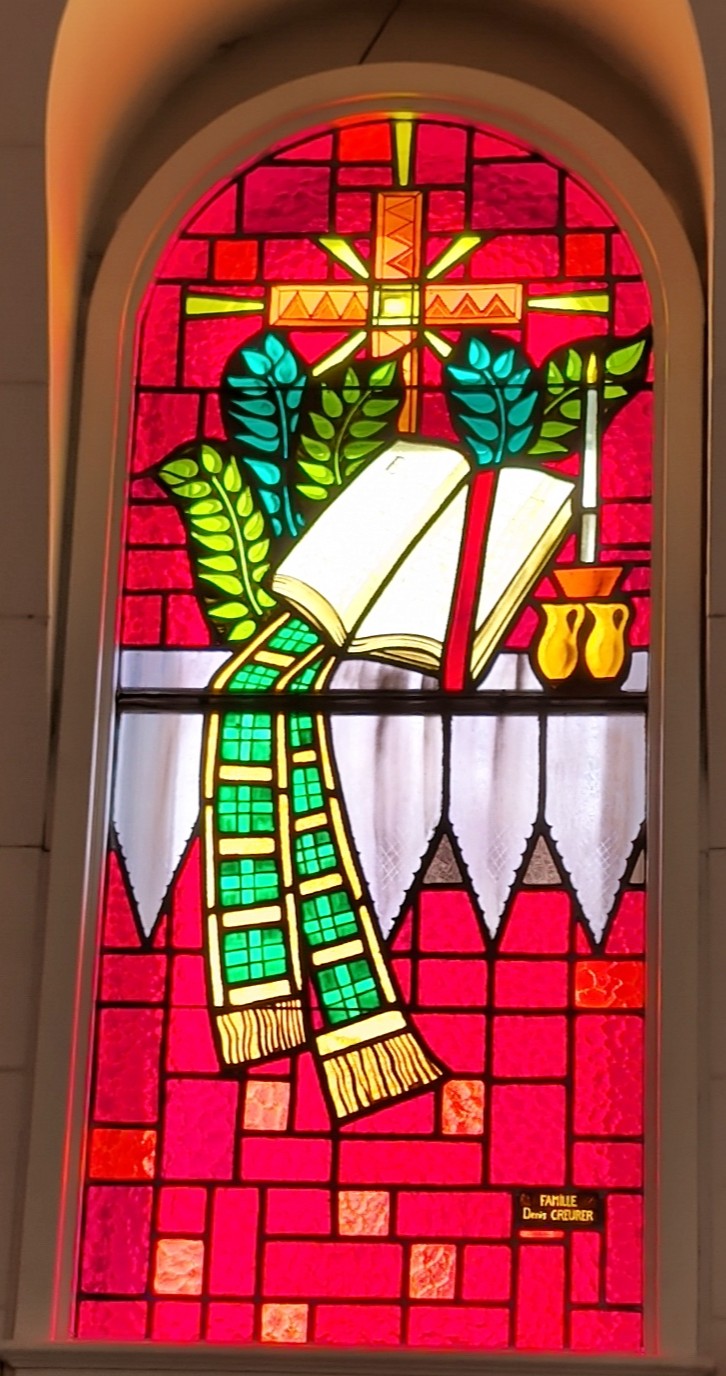
The priest’s stole is evident in this window, as it is the proper item of the priest’s clothing. It is seldom seen on Sunday as it is worn under the chasuble. The scriptures are open, indicating the source from which the priest draws his strength. There is a candle sitting on the altar in the background, reminding us of the duty of the priest to celebrate the Eucharist; and the candle is a sign of Christ’s presence during the mass. Once again the cross is in the background, keeping us ever mindful of the sacrifice of Christ, which we enter into every time we celebrate the Eucharist.
Marriage
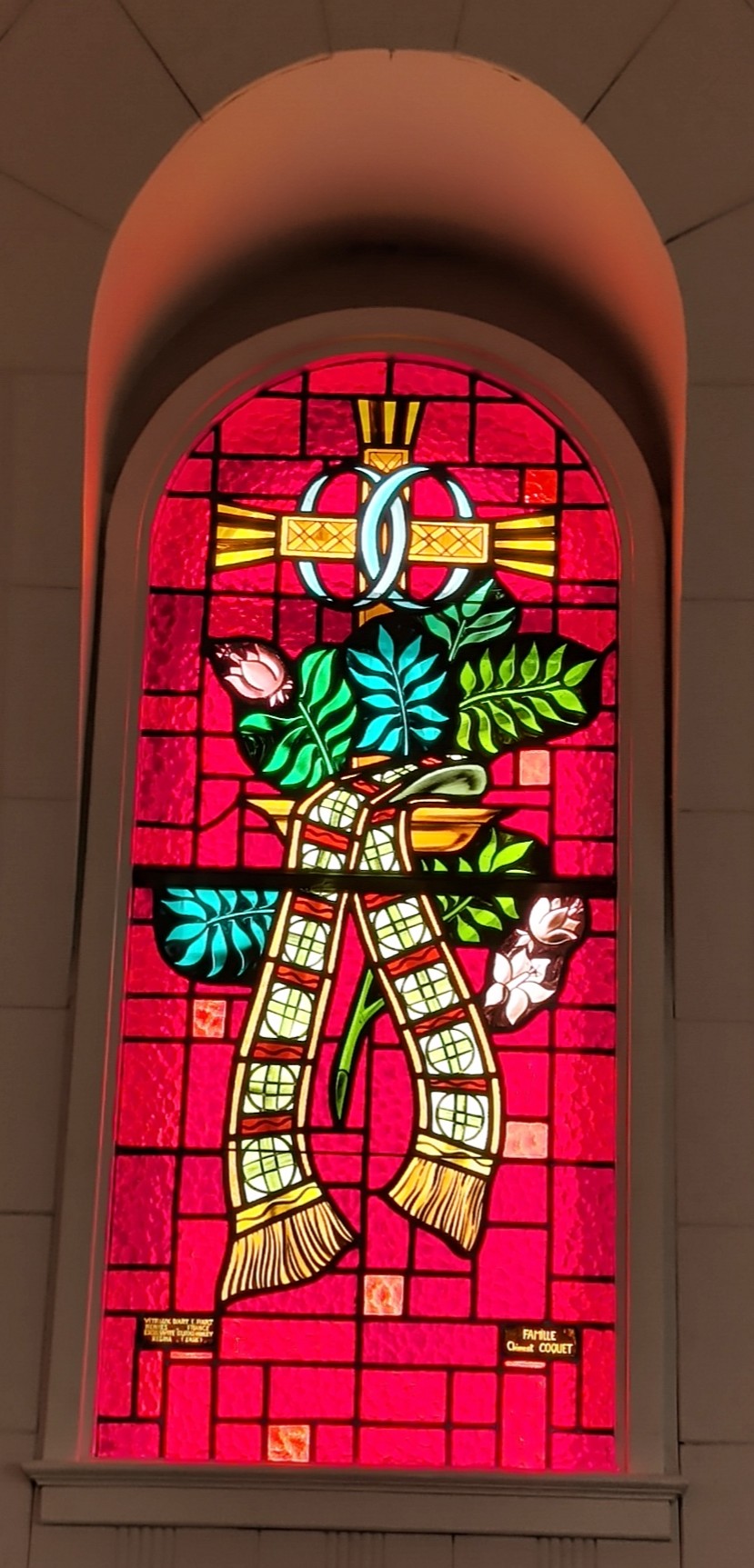
Marriage, along with Holy Orders are the two sacraments of vocation. Married couples are called to share their love with their spouse and their family, and priests are called to be witnesses, in the Christian community. The prominent feature in this window is the two rings intertwined with each other and intertwined with the cross. It is in marriage that the two become one, and are bound together by the love of Christ. It is also a reminder that in marriage each of the spouses must make numerous sacrifices for the other. The priest’s stole flows in front, as the one who celebrates this sacrament, and who witnesses the binding action of God during the celebration. The priest’s stole lies on a plate. In earlier days the rings were brought forward on a plate. Being brought forward on a plate, these rings, (their unity) was the offering the couple was making to the Lord. Roses are present, as they are always a symbol of love.
The windows on the sides of the Church
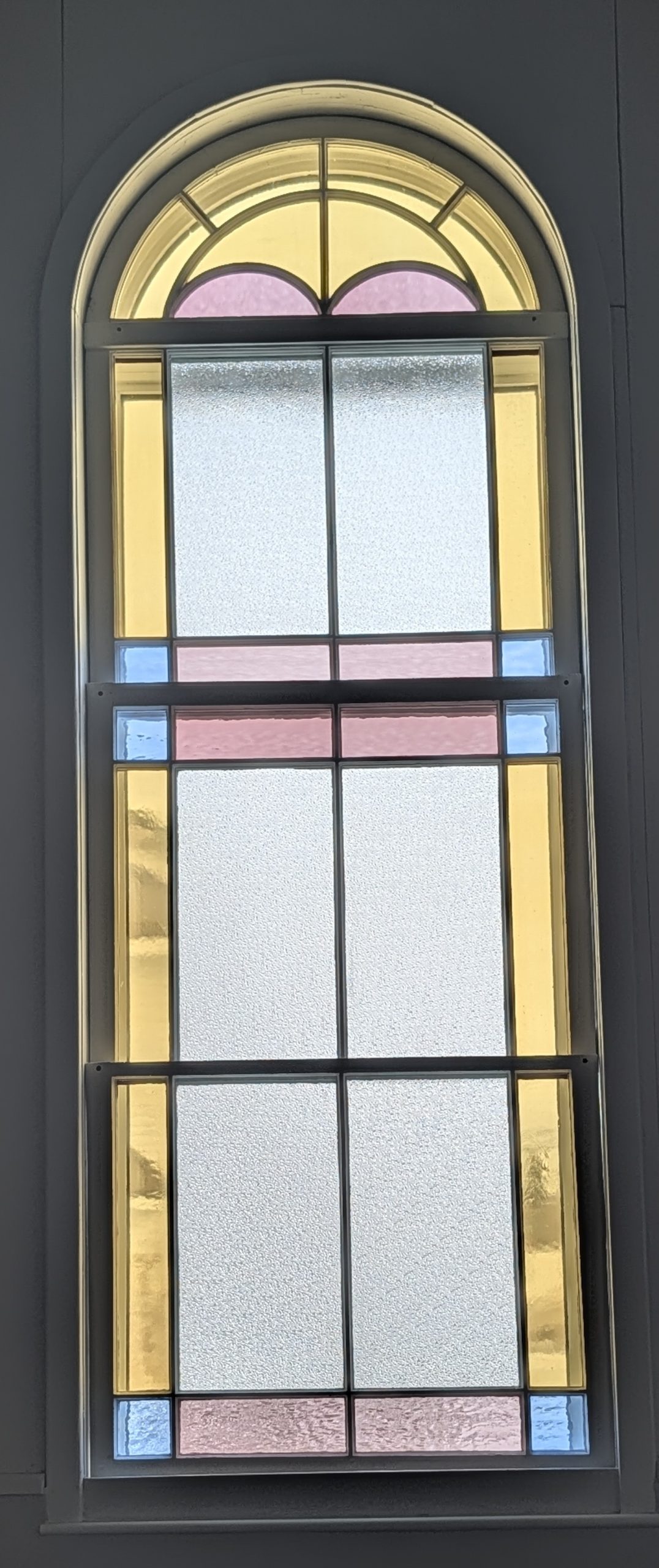
Although not proper stain glass with designs, the side windows consist of colored glass panels. In 1914 construction of a new cathedral in Prince Albert was being undertaken. Fr. Barbier had the forethought to save the windows from the old cathedral and install them in the new church in St. Brieux when it was built three years later.
Window of St. Brieux in the New Entrance
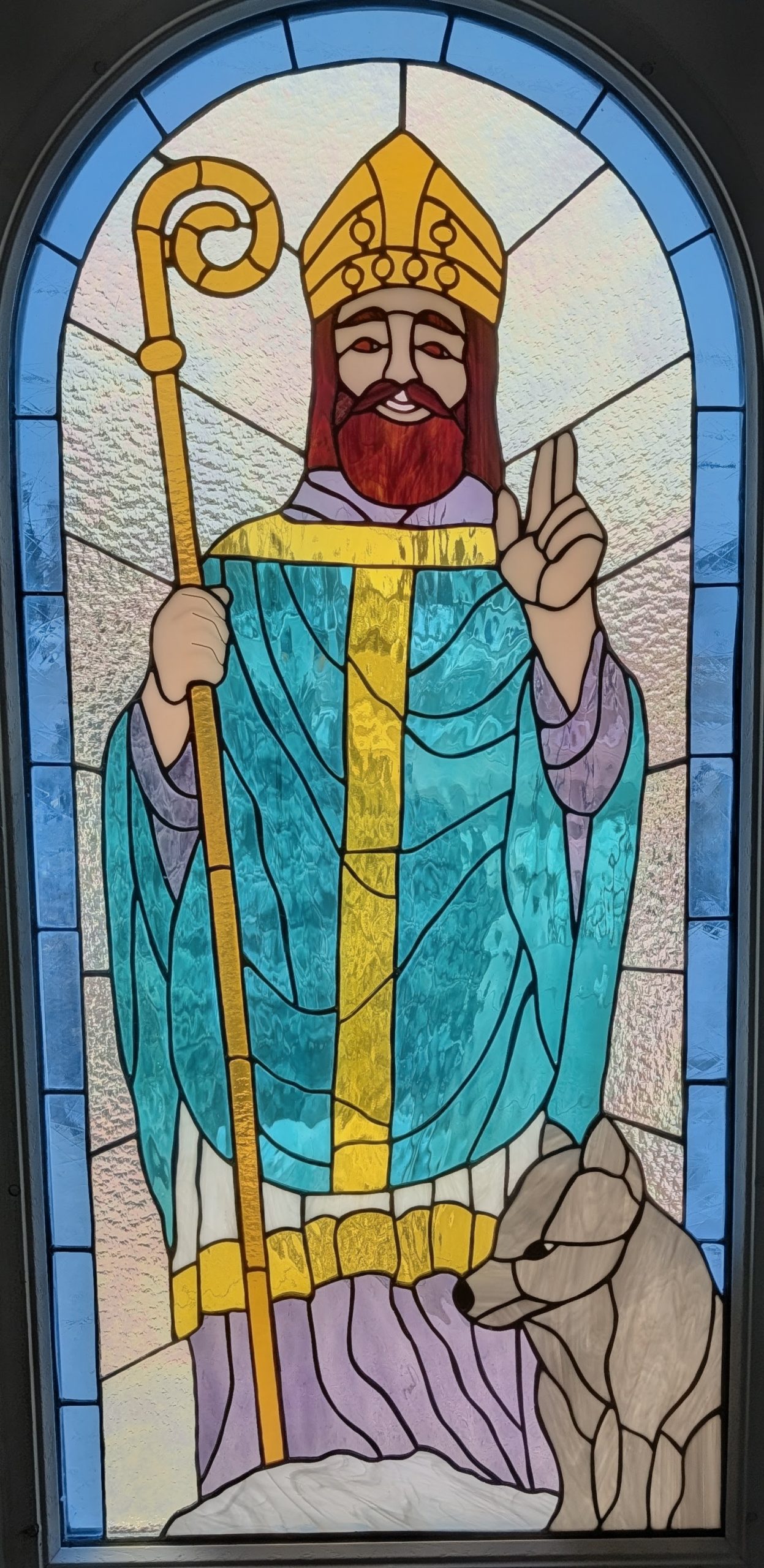 What is different in this stain glass window is the image of a wolf. The wolf has always been a symbol of evil or sin. St. Brieux is often depicted with a wolf, indicating how he, with the help of God, has been able to triumph over sin and evil. Note that St. Brieux is wearing a miter, and holding a crosier, both of these symbols represent the office of a bishop. Let us pray that St. Brieux will help us triumph over sin and evil, both in our world and in our lives.
The Statues with St. Brieux Church (Outside)
St. Brieux (in the Bell Tower) 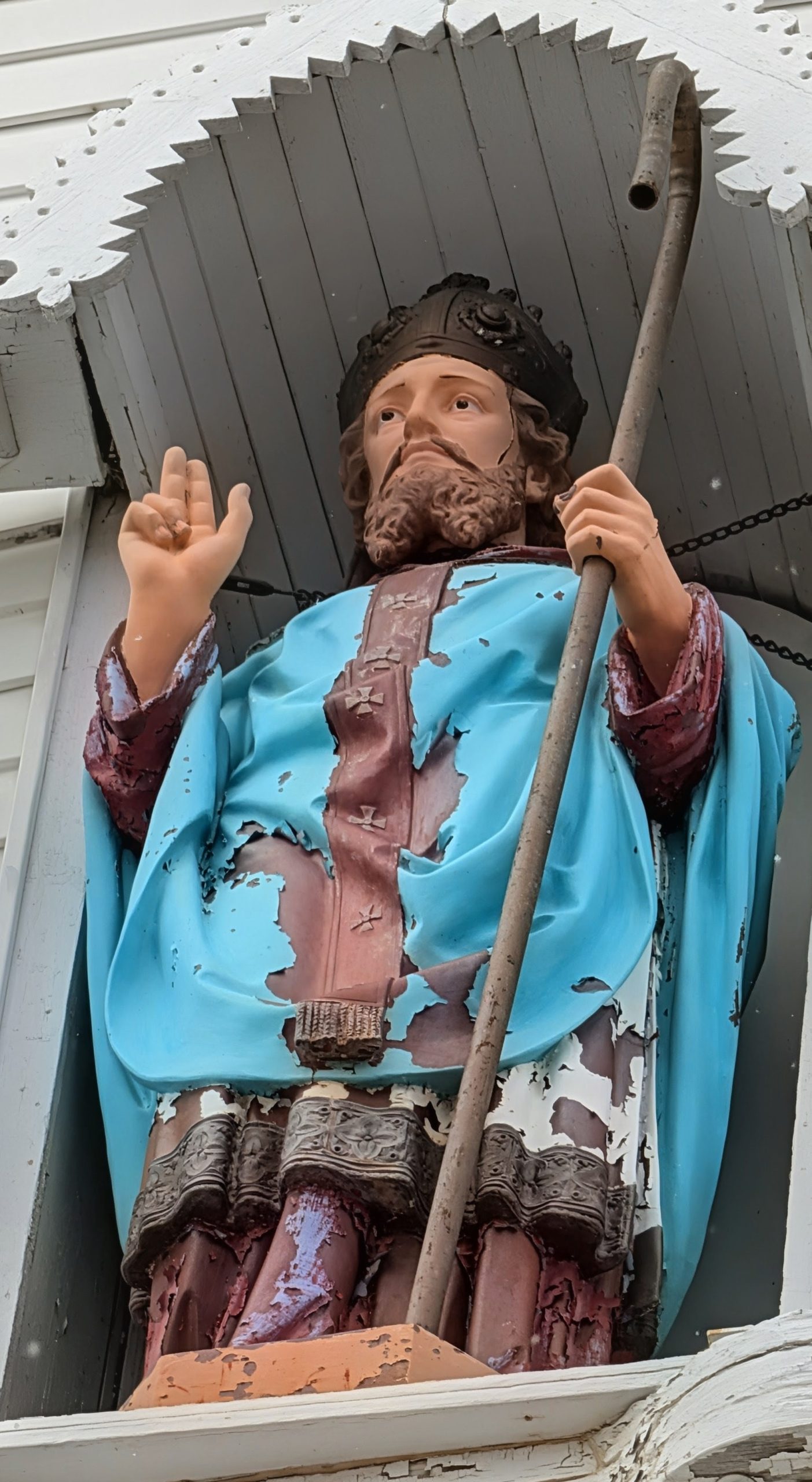
St. Brieux (Brieuc, Briocus, Brioc, or Bru)
St. Brieux is believed to have been born in Dyfed or Cardiganshire, Wales, circa 420. Ordained. Although much of what we read concerning his early years must be received with caution. Other histories have him being born in Ireland.
It has been said that he was of Irish birth and traveled to France later in life. He also converted Conan, a local ruler of Brittany, France, and founded a monastery near the present site of the town of Saint-Brieuc in Brittany. Even before his ordination to the priesthood, St. Brieuc worked several miracles duly chronicled in his “Acts”. In 480, he settled in Armorica, and founded a monastery at Landebaeron. From there he proceeded to Upper Brittany where he established an oratory at a place ever since known as St. Brieuc-des-Vaux, between St. Malo and Land Triguier, of which he was named first bishop. Numerous miracles are cited in the “Acts”, especially his cure of Count Riguel, who gave the saint his own Palace of Champ-du-Rouvre and also the whole manorial estates. Authorities differ as to date of St. Brieuc’s death, but it was probably in 502, or in the early years of the sixth century. He died in his own monastery at St. Brieuc-des-Vaux and was interred in his cathedral church, dedicated to St. Stephen. Baring-Gould says that St. Brieuc is represented as “treading on a dragon”, or else “with a column of fire” as seen at his ordination. His relics were translated to the Church of SS. Sergius and Bacchus of Angers in 865. However, in 1210, a portion of the relics were restored to St. Brieuc Cathedral, where the saint’s ring is also preserved. The festival of St. Brieuc is celebrated on May 1st, but, since 1804, the feast is transferred to the second Sunday after Easter. (From The Catholic Encyclopedia, Volume II)
The Statues with St. Brieux Church (Inside)
Mary (In Sanctuary)
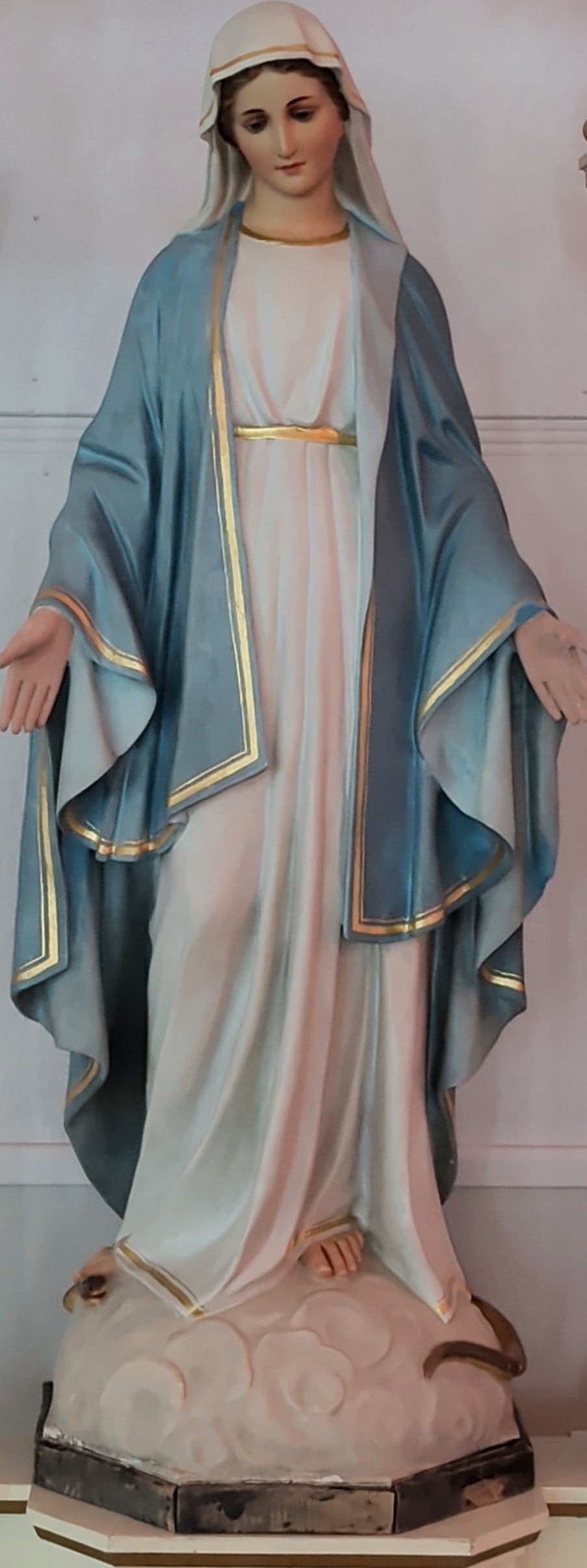
From the earliest times the Blessed Virgin Mary has been honored by the title Theotokos (The Mother of God), whose protection the faithful take refuge in prayer in their perils and needs. Aside for the infancy narratives in which she plays a prominent role, there are only a few scattered references to her elsewhere in the New Testament. Nothing is known of her childhood, but tradition has it that she was the daughter of Joachim and Anne, and born in Jerusalem. As a child she was taken to the temple and took a vow of perpetual virginity. One tradition has her moving to Ephesus, where she died; another tradition has her remaining in Jerusalem, where she died. The belief that her body was assumed into heaven is one of the oldest in the church, and was declared dogma by Pope Pius XII in 1950. Mary’s feast days include: Solemnity of Mary, Mother of God -January 1; Presentation of the Lord, where she presented Jesus in the Temple – February 2; The Annunciation, where the angel told her she would be the mother of the Messiah – March 25; The Visitation, where she visited Elizabeth, the mother of John the Baptist – May 31; The Assumption, whereupon at the end of her earthly existence, she was assumed into heaven.
August 15; The Queenship of Mary, where we recognize her as Queen of heaven -August 22; Her birthday – September 8; Our Lady of Sorrows, her association with all those who are in sorrow – September 15; Our Lady of the Rosary – October 7; Her Immaculate Conception, meaning she was born without the stain of Original Sin -December 8; The Immaculate Heart of Mary, acknowledging how she pours her love upon all people – the Saturday following the second Sunday of Pentecost. The months of May and October have traditionally been months of special Marian devotions. One of the pre-eminent features of modern Catholicism has been the appearances of Mary in the last century, notably Lourdes, Fatima and Guadalupe (December 12). (From Pocket Dictionary of the Saints).
St. Joseph (In Sanctuary)
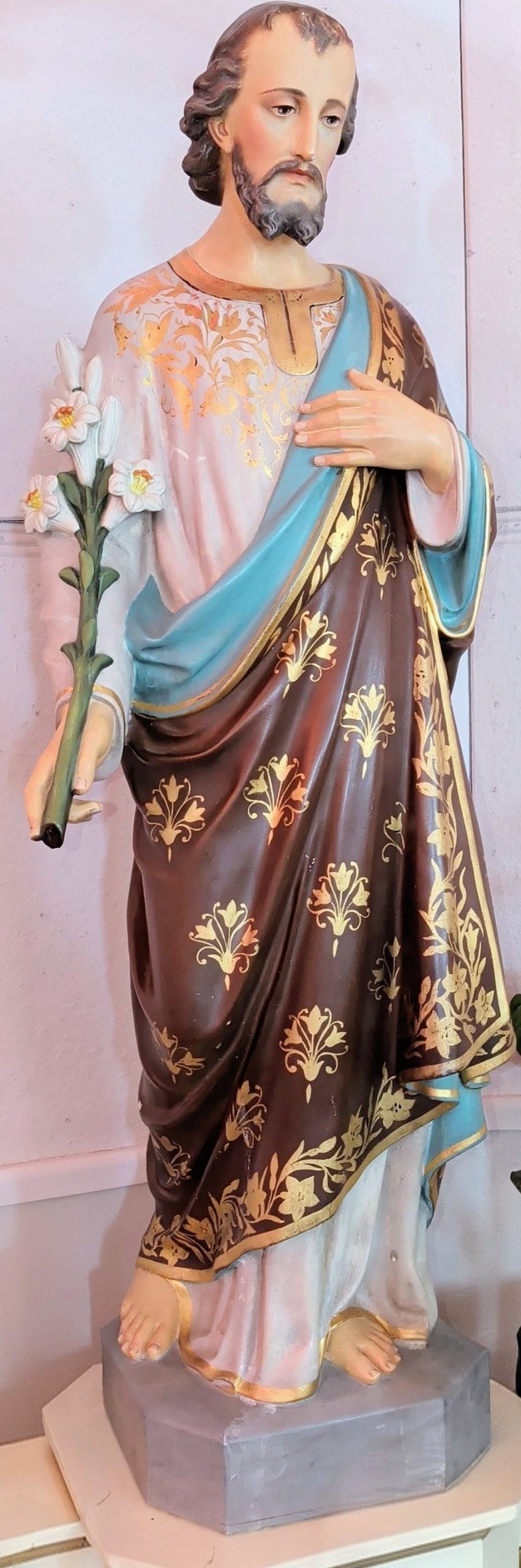
Our only reliable information about Joseph is found in the infancy narratives of Matthew’s gospel. According to them Joseph is a royal descendant of David. Joseph’s family came from Bethlehem, in Judea, but he moved to Nazareth, in Galilee, where he became a builder. It was not until the fifteenth century that the veneration of St. Joseph became widespread, in the West. Joseph was declared: 1) The Patron of the Universal Church by Pope Pius IX in 1870; 2) A model for all fathers by Pope Leo XIII; 3) Protector of working men by Pope Benedict XV; 4) The patron of social justice by Pope Pius XI. His feast day is March 19.
St. Anne (Back of the Church) (Hebrew, Hannah, grace; also spelled Ann, or Anna)
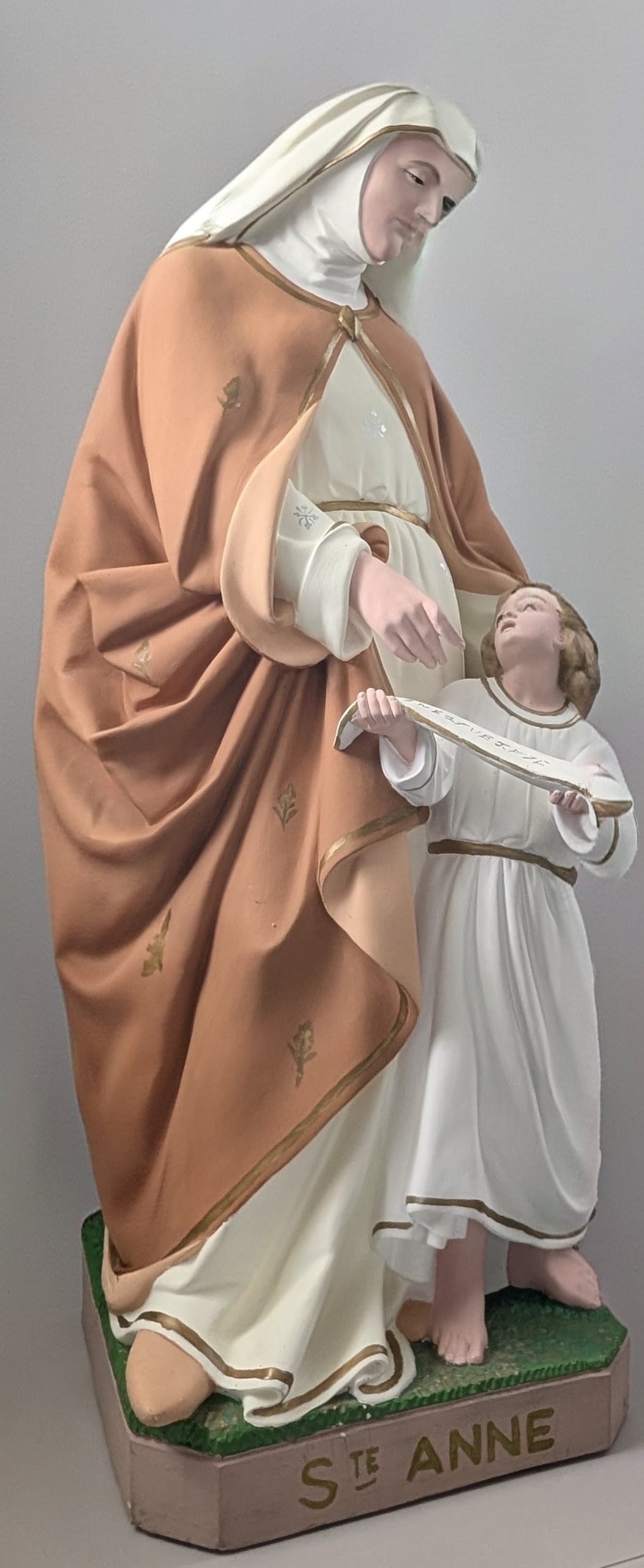
Anne is the traditional name of the mother of the Blessed Virgin Mary. All our information concerning the names and lives of St. Joachim and St. Anne, the parents of Mary, is derived from apocryphal literature (Early writings with questionable authenticity ie. the Gospel of the Nativity of Mary, the Gospel of Pseudo-Matthew and the Protoevangelium of James).
The Protoevangelium gives the following account: In Nazareth there lived a rich and pious couple, Joachim and Hannah. They were childless. When on a feast day Joachim presented himself to offer sacrifice in the temple, he was repulsed by a certain Ruben, under the pretext that men without offspring were unworthy to be admitted. Whereupon Joachim, bowed down with grief, did not return home, but went into the mountains to make his plaint to God in solitude. Also Hannah, having learned the reason of the prolonged absence of her husband, cried to the Lord to take away from her the curse of sterility, promising to dedicate her child to the service of God. Their prayers were heard; an angel came to Hannah and said: “Hannah, the Lord has looked upon thy tears; thou shalt conceive and give birth and the fruit of thy womb shall be blessed by all the world.” The angel made the same promise to Joachim, who returned to his wife. Hannah gave birth to a daughter whom she called Miriam (Mary). Since this story is apparently a reproduction of the biblical account of the conception of Samuel, whose mother was also called Hannah, even the name of the mother of Mary seems to be doubtful.
St. Anne is the patroness of Brittany. In Canada, where she is the principal patron of the province of Quebec, the shrine of St. Anne de Beaupréé is well known. St. Anne is patroness of all Christian Mothers and also women in labor; she is represented holding the Blessed Virgin Mary in her lap, who again carries in her arms the child Jesus. She is also patroness of miners, Christ being compared to gold, Mary to silver. Her feast day is July 26.
(From The Catholic Encyclopedia, Volume 1)
St. Anthony of Padua (Prayer Alcove)
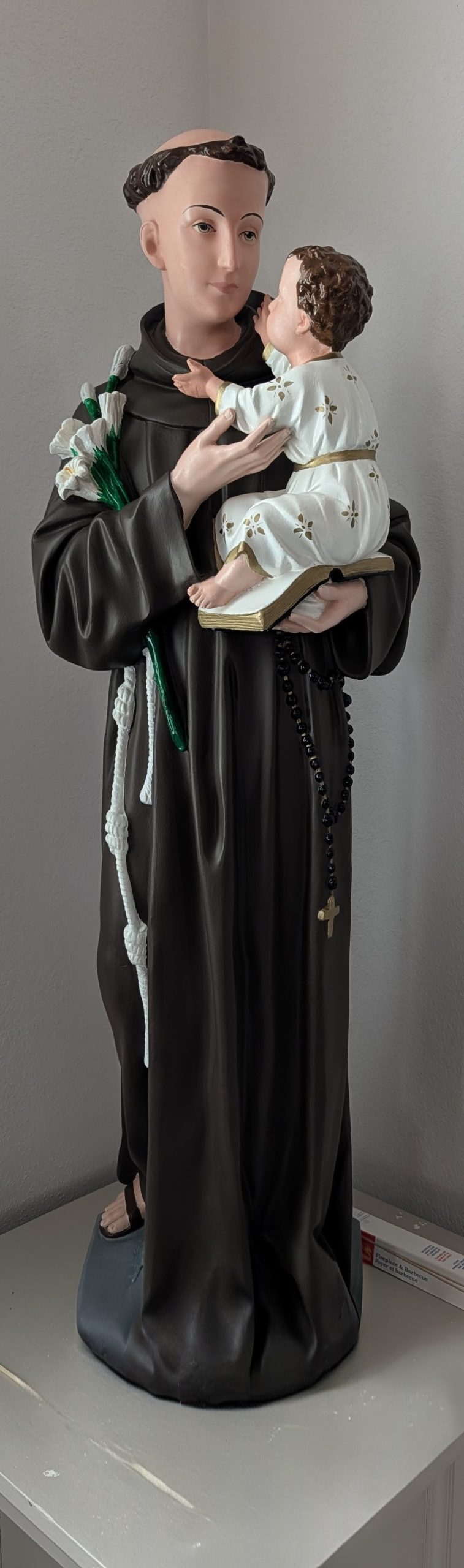
St. Anthony was born in Lisbon in 1195. At the age of fifteen, he joined the Canons Regular of St. Augustine, in the convent of St. Vincent, just outside the city walls (1210). He later transferred to the Franciscans (1221), and went to preach to the Moors. His sermons were noted for their eloquence, fire, and persuasiveness; attracted huge crowds everywhere he went. He settled in Padua after 1226 and his bold and brilliant preaching attacking corruption and wrongdoing wherever he saw them, and he completely reformed the city. He worked to abolish debtors prisons, helped the poor, and worked tirelessly against heretics. Exhausted form overwork he died in 1231 at the age of 36.
Stories of the miracles Anthony worked and his prowess are legendary, and he was undoubtedly one of the greatest preachers of all times. His contemporaries called him “Hammer of the Heretics” and “Living Ark of the Covenant” and “Wonder Worker.” He is the patron of the poor and oppressed, and is commonly referred to today as the “finder of lost articles.” He is typically depicted with a book and the Infant Child Jesus, to whom He miraculously appeared. His feast day is June 13. (From Pocket Dictionary of the Saints).
St. Thérèse of Lisieux (Prayer Alcove)
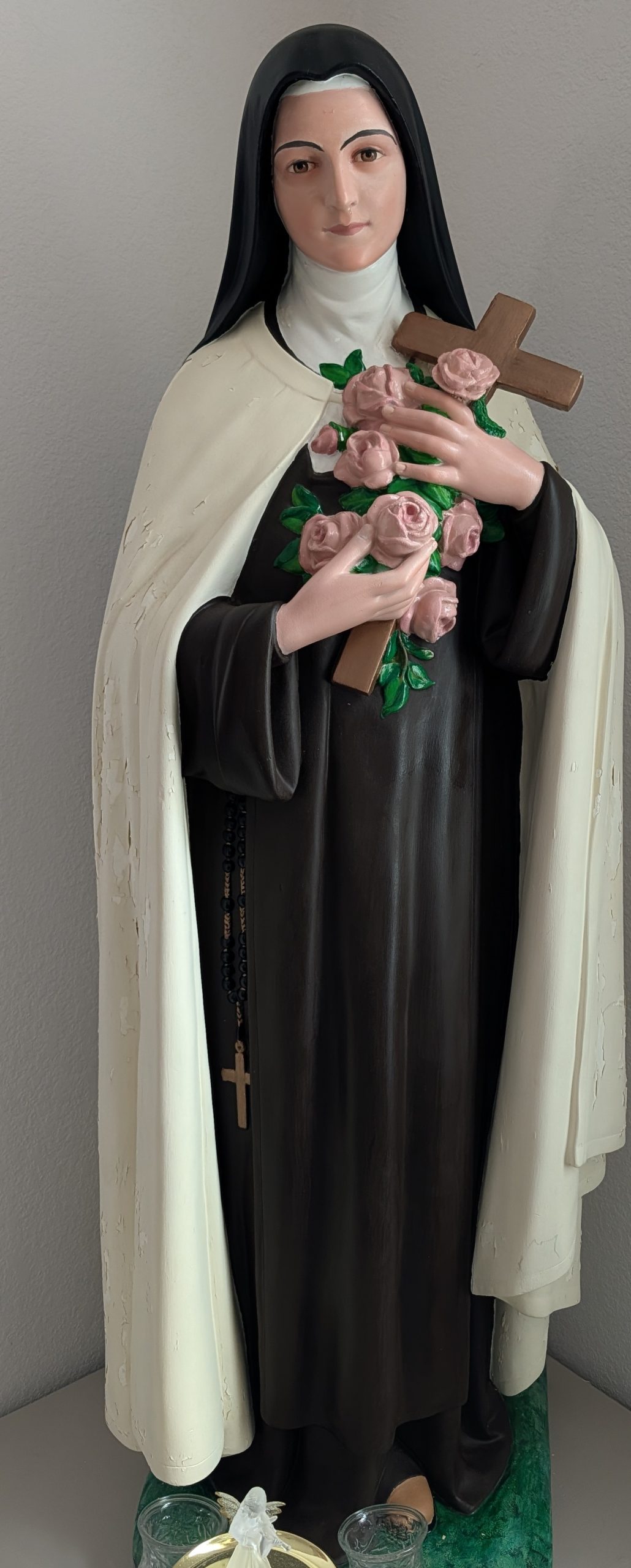
(Sister Teresa of the Child Jesus) Better known as “The Little Flower of Jesus”
Thérèse was a born in Alenççon, France, on January 2, 1873. She was the ninth child of saintly parents, Louis and Zéélie Martin. Brought up in an atmosphere of faith where every virtue and aspiration were carefully nurtured and developed, her vocation manifested itself when she was still only a child.
When she was only fifteen she applied for permission to enter the Carmelite Convent, and being refused by the superior, went to Rome with her father, to seek the consent of the Holy Father, Leo XIII. He preferred to leave the decision in the hands of the superior, who finally consented, and on April 9, 1888, at the unusual age of fifteen, Thérèse Martin entered the convent of Lisieux where two of her sisters had preceded her. The account of her childhood and the eleven years of her religious life, marked by graces and constant growth in holiness, is given by Sr. Thérèse in her autobiography; written in obedience to her superior and published two years after her death (September 30, 1897). The Story of a Soul became one of the most widely read autobiographies. She was canonized in 1925 and declared copatron of the missions (With Francis Xavier). She is also the patroness of aviators and in 1944 was named, along with Joan of Arc, copatroness of France. Her feast day is October 1st. (From The Catholic Encyclopedia, Volume XVII (Supplement I)
Sacred Heart of Jesus (Above Tabernacle)
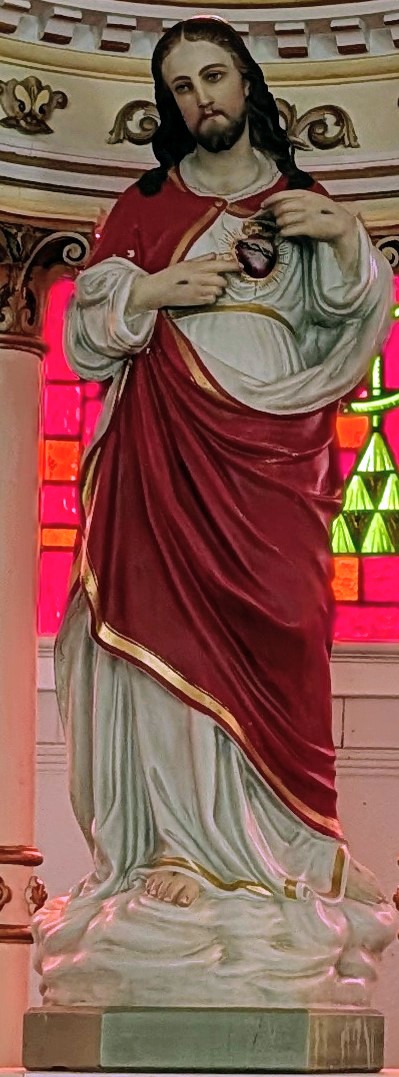
The Solemnity of the Sacred Heart of Jesus is celebrated on the Friday following the second Sunday after Pentecost. It was established by Pope Clement XIII in 1765. Devotion to the Sacred Heart is a special devotion to Jesus. The Sacred Heart of Jesus is a special devotion to the adorable heart of Jesus Christ. The “Heart” is first and foremost the vital organ which throbs within our bodies. But our “Heart” is also connected to our emotional and moral self. The Sacred Heart is therefore, not only the physically heart of Jesus, but it is also a metaphor of His love for us; as the “Heart” of Christ is also a symbol of his emotional and moral life. Consequently, devotion to the Sacred Heart may be defined as devotion to the human heart of Jesus Christ, in so far as this “Heart” represents and recalls his love, and his sacrifice. This love and sacrifice is symbolized by a heart being wounded. Since the heart of Jesus appears to us as the sensible sign of His love the visible wound in the Heart will naturally recall the invisible wound of this love.
On June 11, 1899, Pope Leo XIII solemnly consecrated all humanity to the Sacred Heart of Jesus.
Angels (Over the Tabernacle)
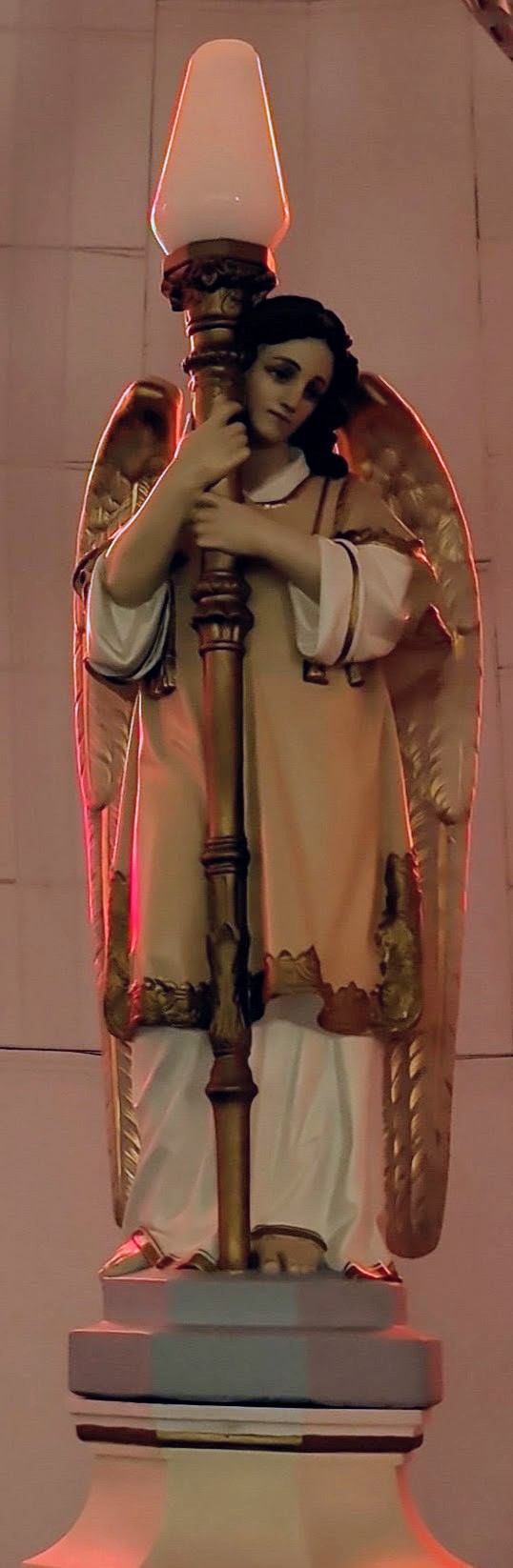
Angelos (Greek) is from angello “to deliver a message.” Angels are seen as messenger of God. Bearers in a sense of God’s word. Angels are spirits (Heb.1.14) and do not have bodies as human beings do, therefore, they can take whatever form necessary. Angels are seen numerous times throughout the scriptures, always helping people come to an understanding of God’s will. The two angels over the tabernacle are symbolic of the two cherubim (angels) that guard the ark of the covenant which Moses built to house the “Ten Commandments” (Exodus 37:7). The Bible represents the angels not only as our guardians, but also as actually interceding for us. “The angel Raphael (Tob. 12:12) says: “I offered thy prayer to the Lord.” It is through his angels that God has made himself known. Catholic Doctrine teaches that from its beginning until death, human life is surrounded by angels. Beside each person stands an angel as protector leading us to Christ (CCC 336). The feast of Guardian Angels is October 2nd. The feast of Archangels Michael, Gabriel and Raphael is September 29.
Tabernacle Door
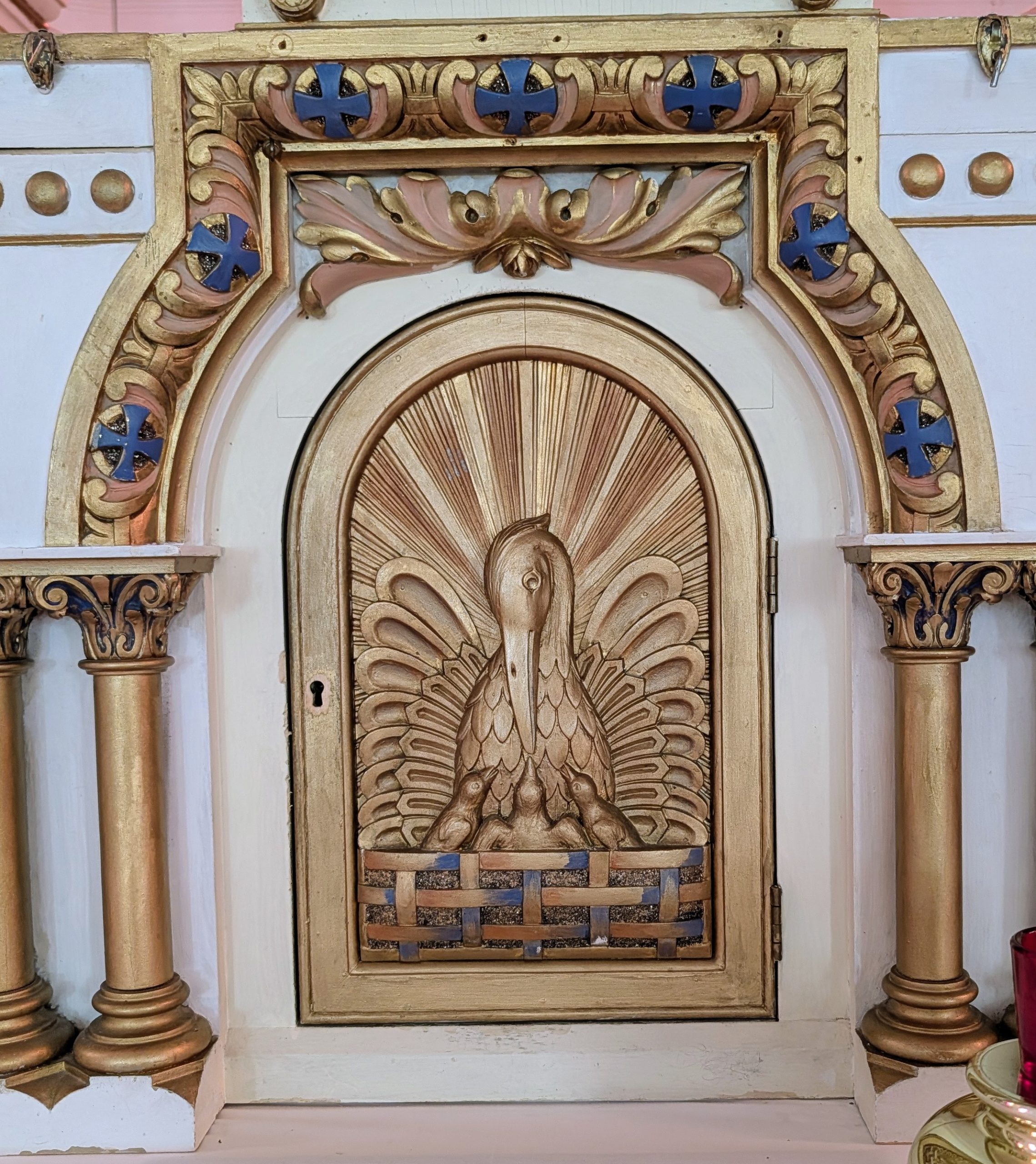
An interesting design, which is not often seen in churches. The scene is of a mother pelican feeding her babies. The symbol of a pelican goes back a long way in the history of the Church. There are two sources of this symbol. The first is due to a poor understanding of the feeding habits of pelicans. It was initially believed that a mother pelican would prick her own breast and the young babies would feed off of her own blood. A parallel of Jesus’s side being pierced while he was hanging on the cross, and the church being fed by his blood. A second source is that image of what the mother was feeding her babies. A mother pelican would go out and catch some fish (I-CH-TH-U-S a Greek acrostic from Iseous Christos Theo Uios Soter in English it would read Jesus Christ Son of God Savior). These fish would then be fed to her babies. A reminder that we too are fed a meal of “Ithchus” whenever we celebrate the Eucharist. The Tabernacle is therefore a place where the Body of Christ, or “Ithchus” or Fish is stored.
Alpha and Omega
ΑΩ
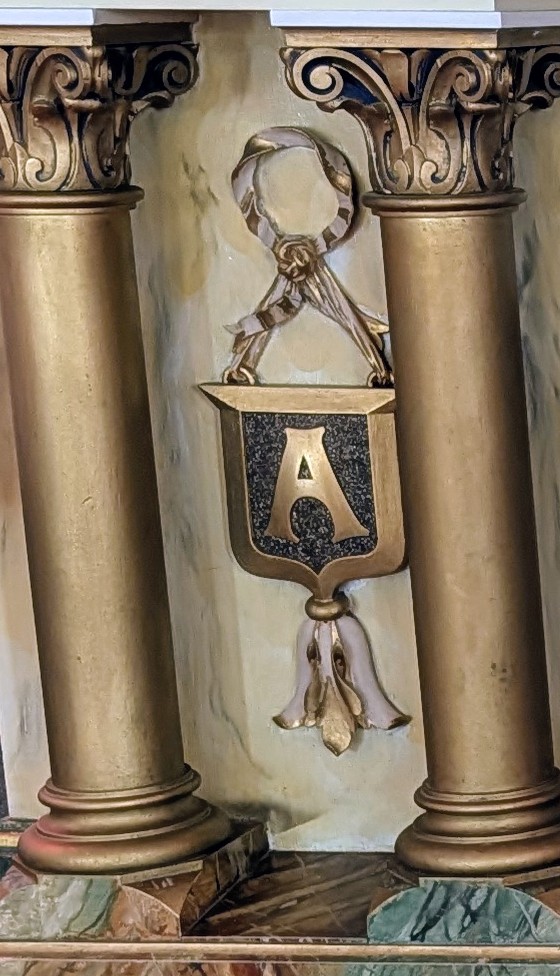
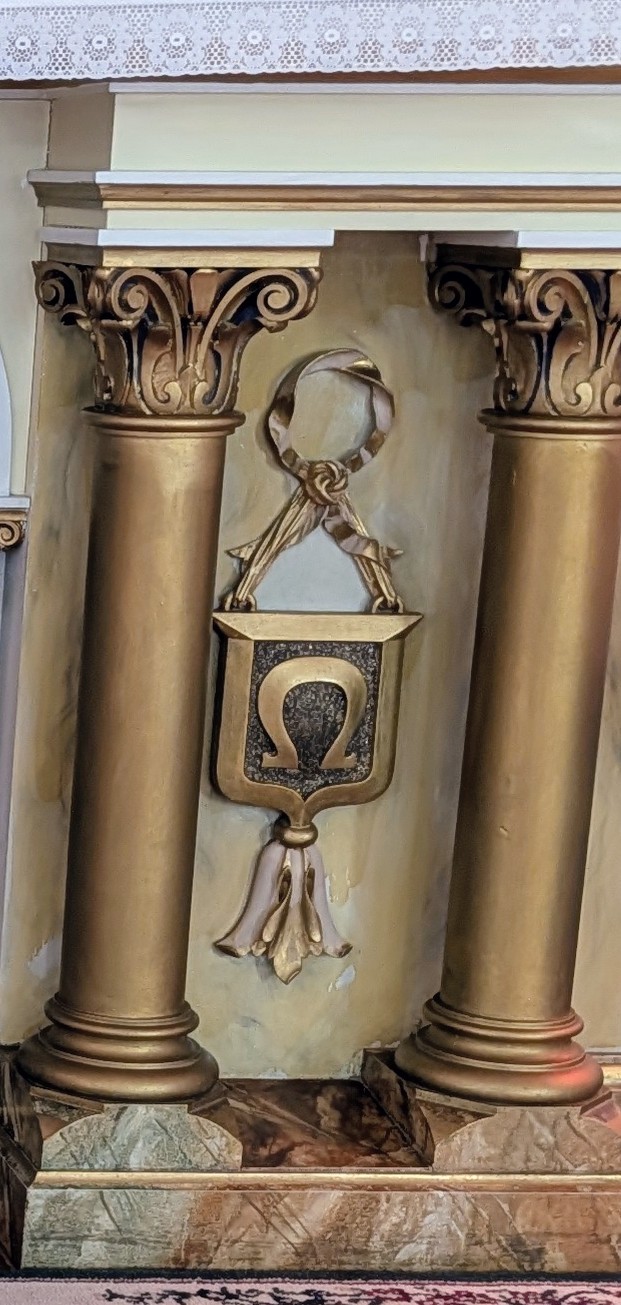
Alpha and Omega are the first and the last letters of the Greek alphabet. They have been used from the fourth century as a symbol of our Savior. These letters are referred to in the book of Revelation where Christ is “the First and the Last, who was dead and has come to life again.” (Rev. 2:8). And again, “I am the Alpha and Omega, the first and the last, the beginning and the end.” (Rev. 22:13). It is interesting to note what happens in the Hebrew alphabet when the first and last letters are combined. The Hebrew word for truth is Emeth. It is composed of three letters: Aleph-Alpha, Mem=My, and Thaw Theta. The Aleph and the Thaw are the first and last letters of the Hebrew alphabet, just as the Alpha and Omega are the first and last letters of the Greek alphabet. Thus the term Emeth (truth) begins with the first letter of the alphabet and ends with the last. Therefore “Emeth” means “That God is the first of all things, will be the last of all things, and whom is the source of all truth.” (From The Catholic Encyclopedia)
Scene of the Last Supper
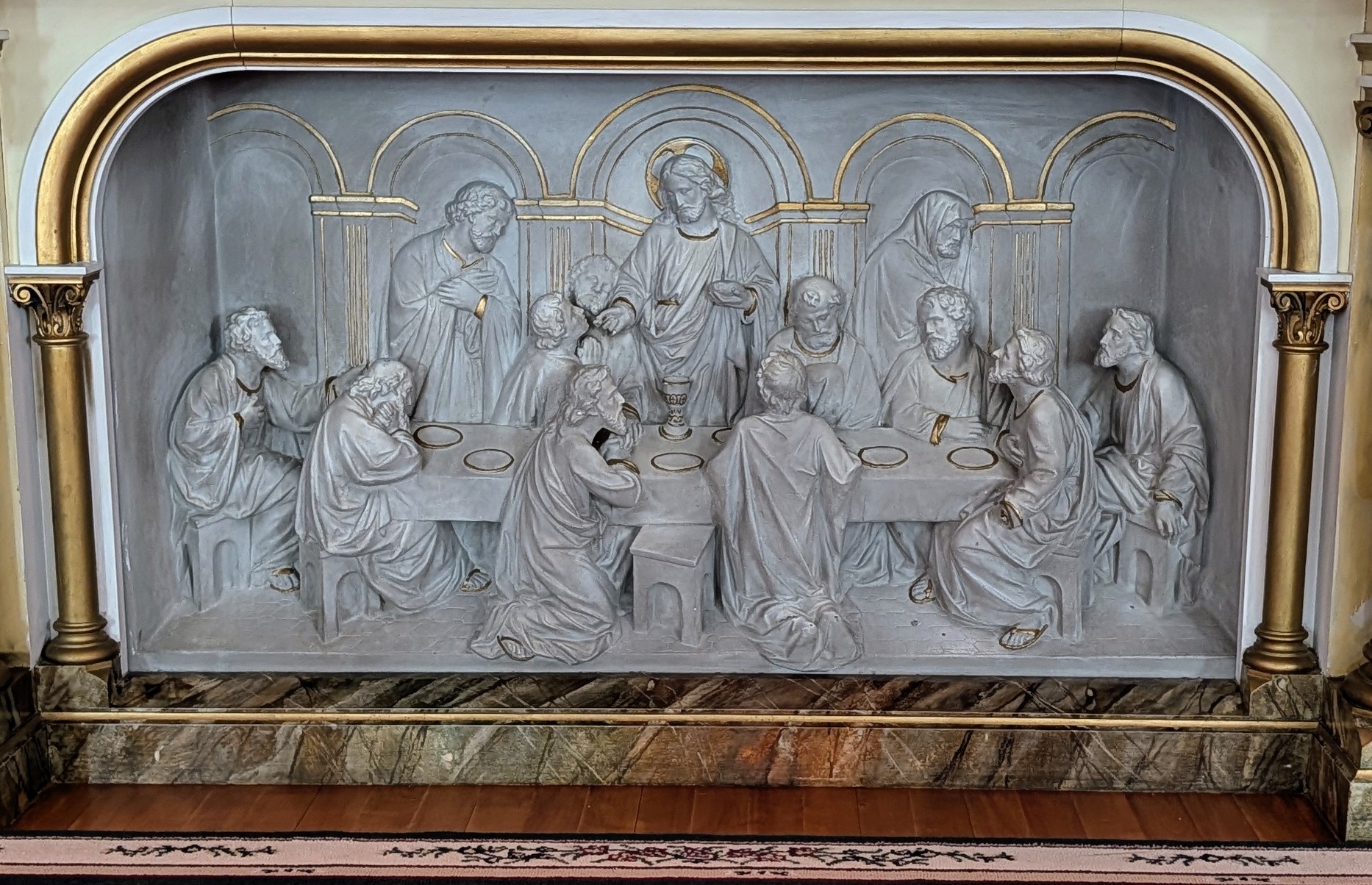
The Last Supper is the last meal Jesus celebrated with his apostles, the night before his passion. It is the meal during which he instituted the Eucharist, and gave them the instruction “Do this in memory of me.” Many artists have portrayed a wonderful depiction of the last supper. Many are fooled into thinking that this depiction has only eleven apostles, however, upon close examination one will notice a head that is almost hidden.
Sanctuary Furniture
Altar
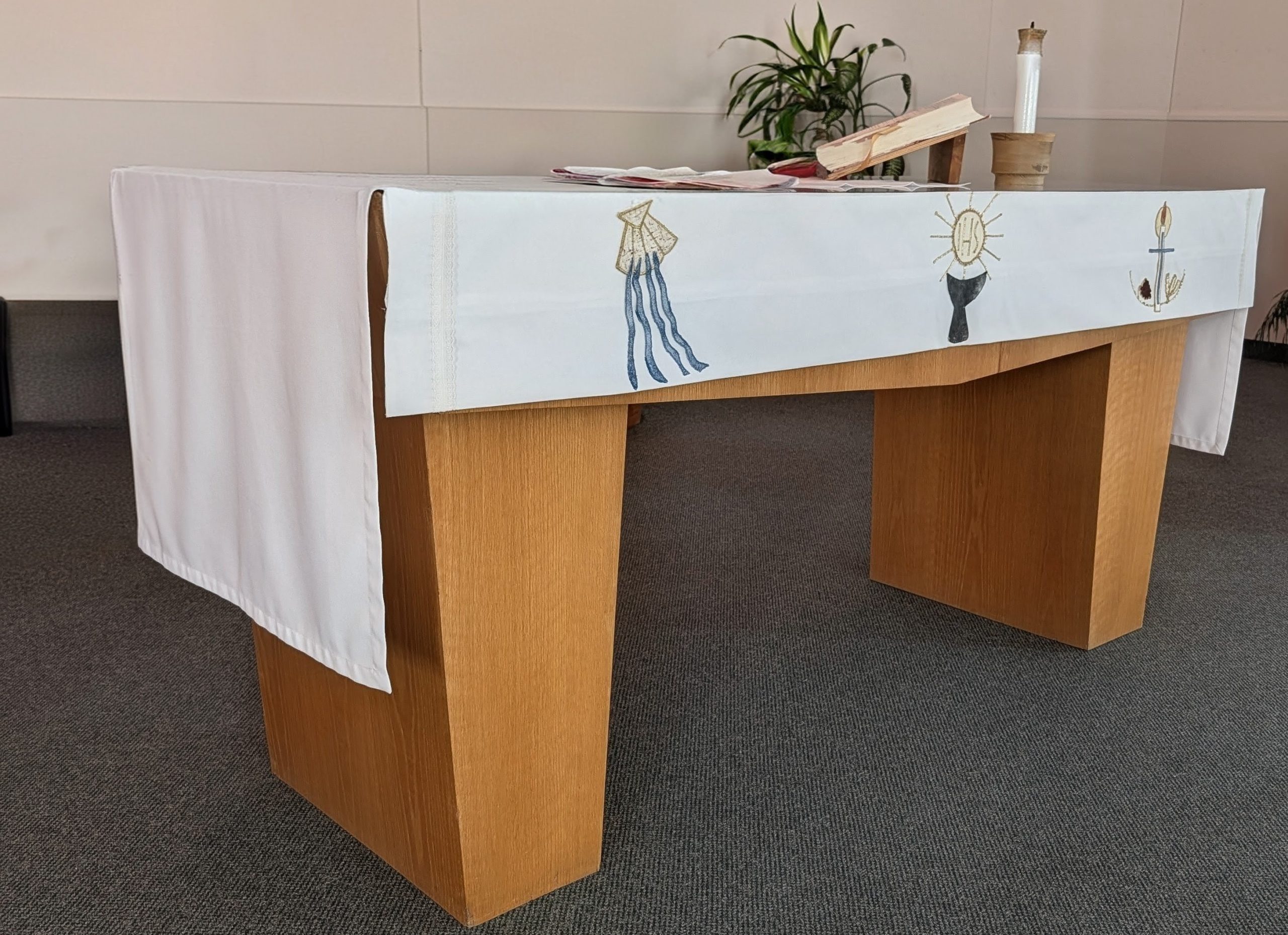
The altar is a solid table for the sacrifice (or meal) of the Eucharist. According to the early Church Fathers, the altar represents the mediating power between heaven and earth. Embedded in the altar is an altar stone. No longer required in new altars, altar stones were originally identified as the altar itself. Usually the altar stone was big enough to hold the chalice and paten (small container for bread). Its upper surface bears five crosses, for Christ’s five wounds. Within the altar stone is embedded relics of two martyr saints. If you ever see the altar without an altar cloth be sure to go up and show your children, or grandchildren the altar stone.
Chair
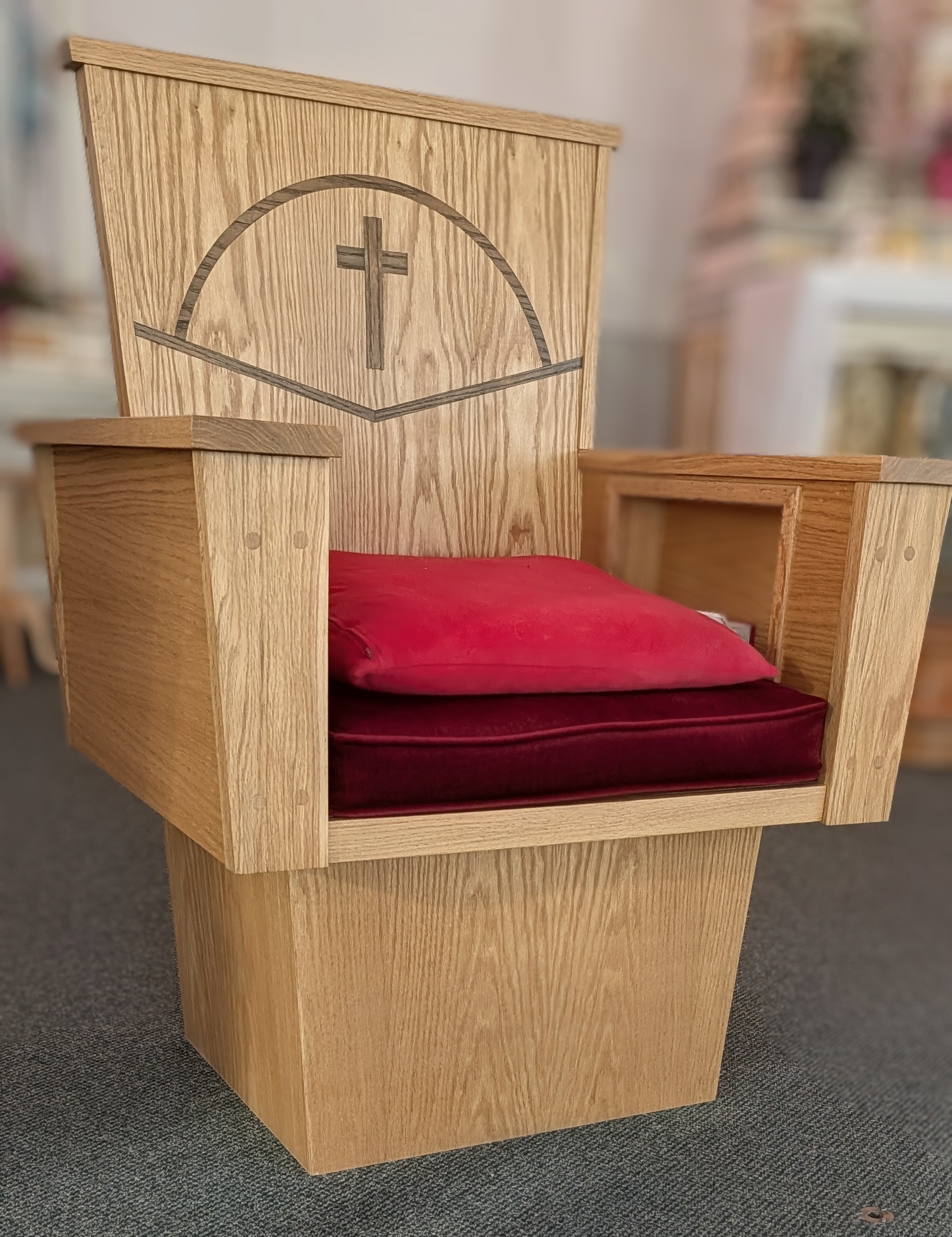

The presider’s chair is the proper place for the presider at the Eucharist. It is not a utilitarian piece of furniture but has a theological significance in relation to the community. The presider’s chair is set up opposite and in sight of the congregation. It is an expression of the hierarchical structure of God’s people. In the person of the minister, Christ himself presides over the service. The office it represents is part of the community’s life. Our present presider’s chair was build by Paul Thomas, in 2002. The design on the back represents a rainbow between two mountains. The rainbow is a sign of God’s covenant with humanity, and a mountain has always been a strong symbol of the dwelling place of God.
Ambo
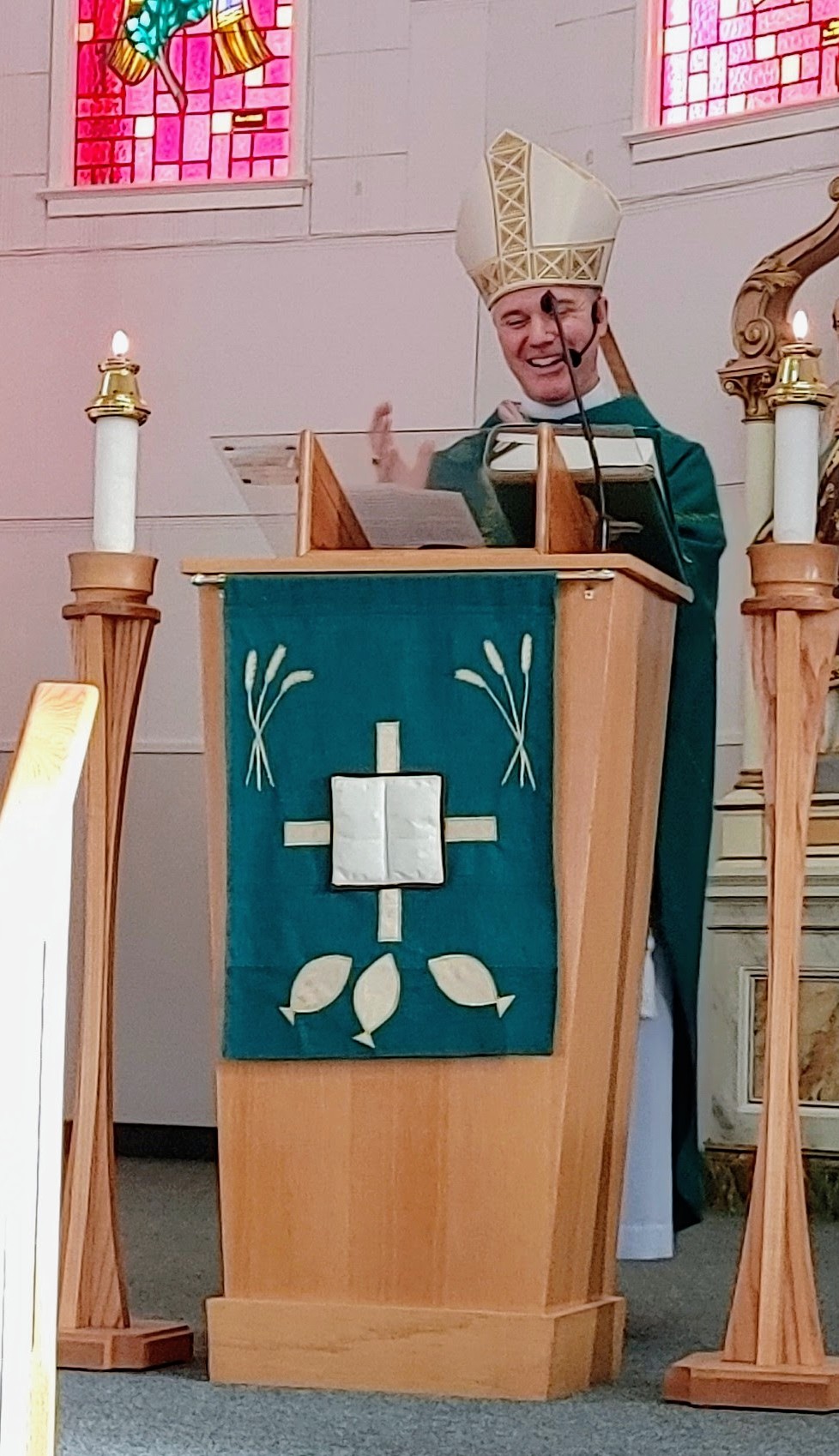
The proper place from which the scriptures are proclaimed, and the Word of God is preached. In the liturgy, the transition from the Liturgy of the Word to the Liturgy of the Eucharist is made evident by the shift of attention from ambo to altar. The close proximity of the ambo and the altar make it clear that the Word and the Eucharist belong together.
These three pieces of furniture are used in the celebration of the Eucharist and should be treated with reverence. At no time should they be used casually as a place of rest, or a place to put things, even for a short time.
Way of the Cross
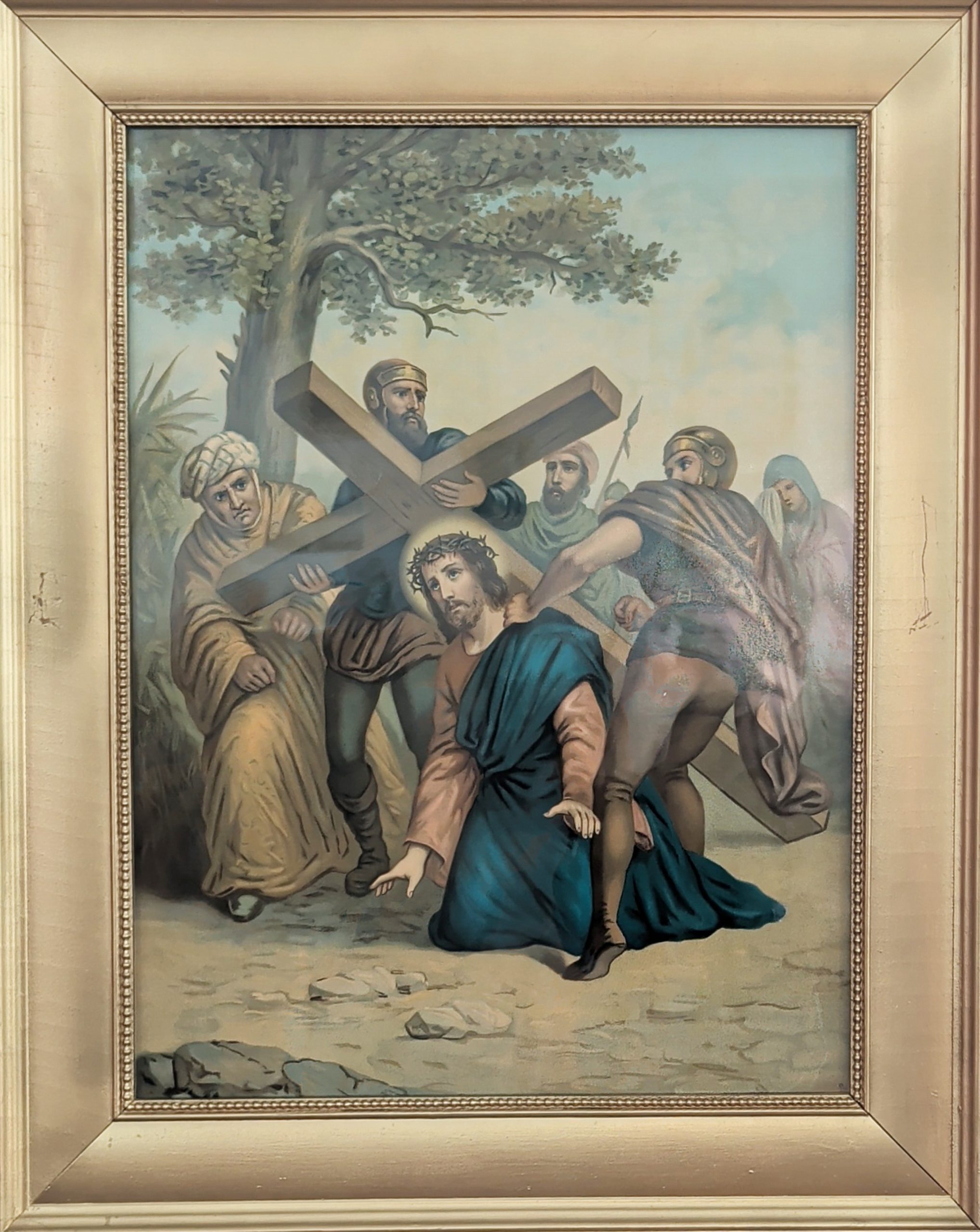
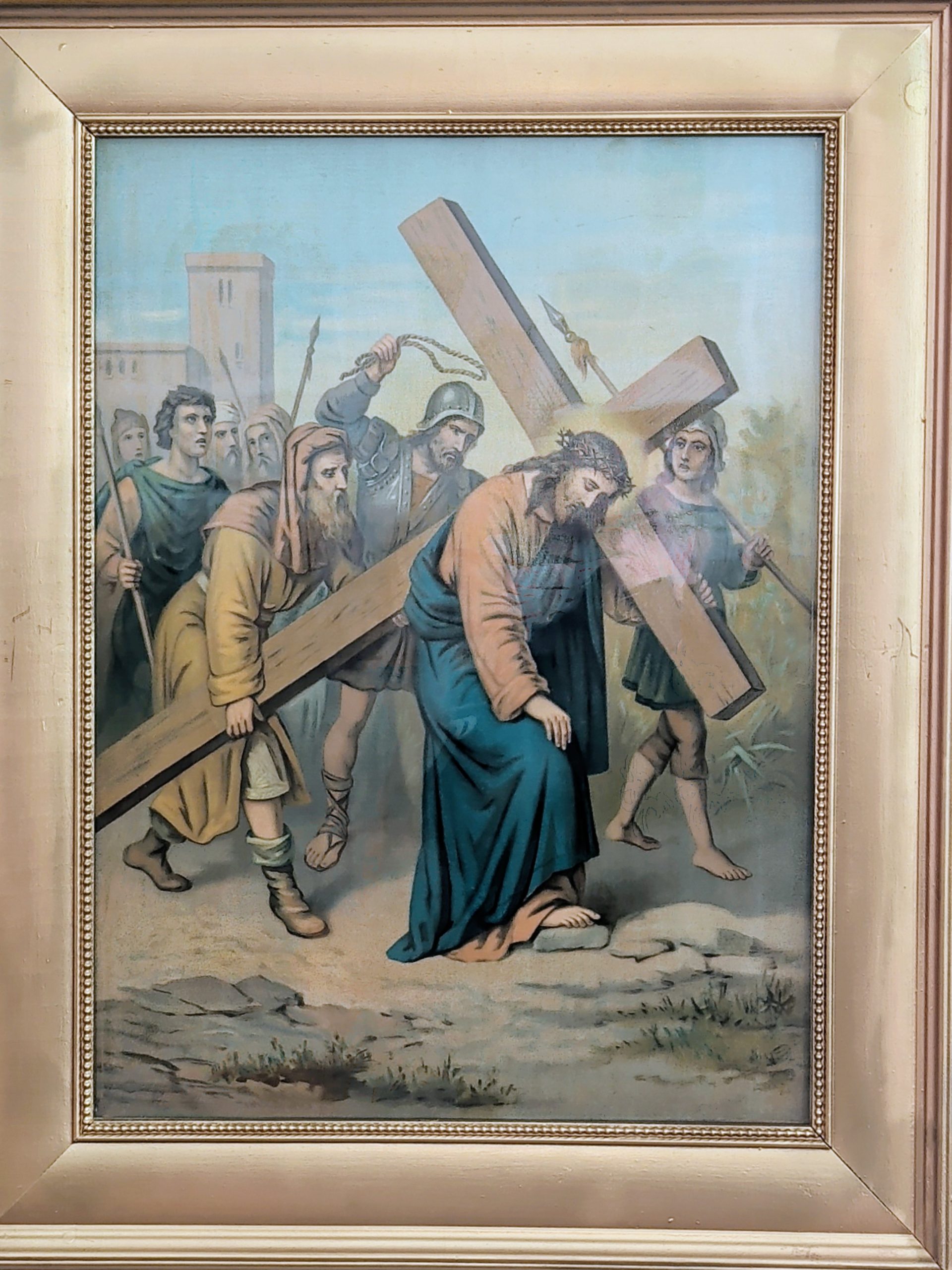
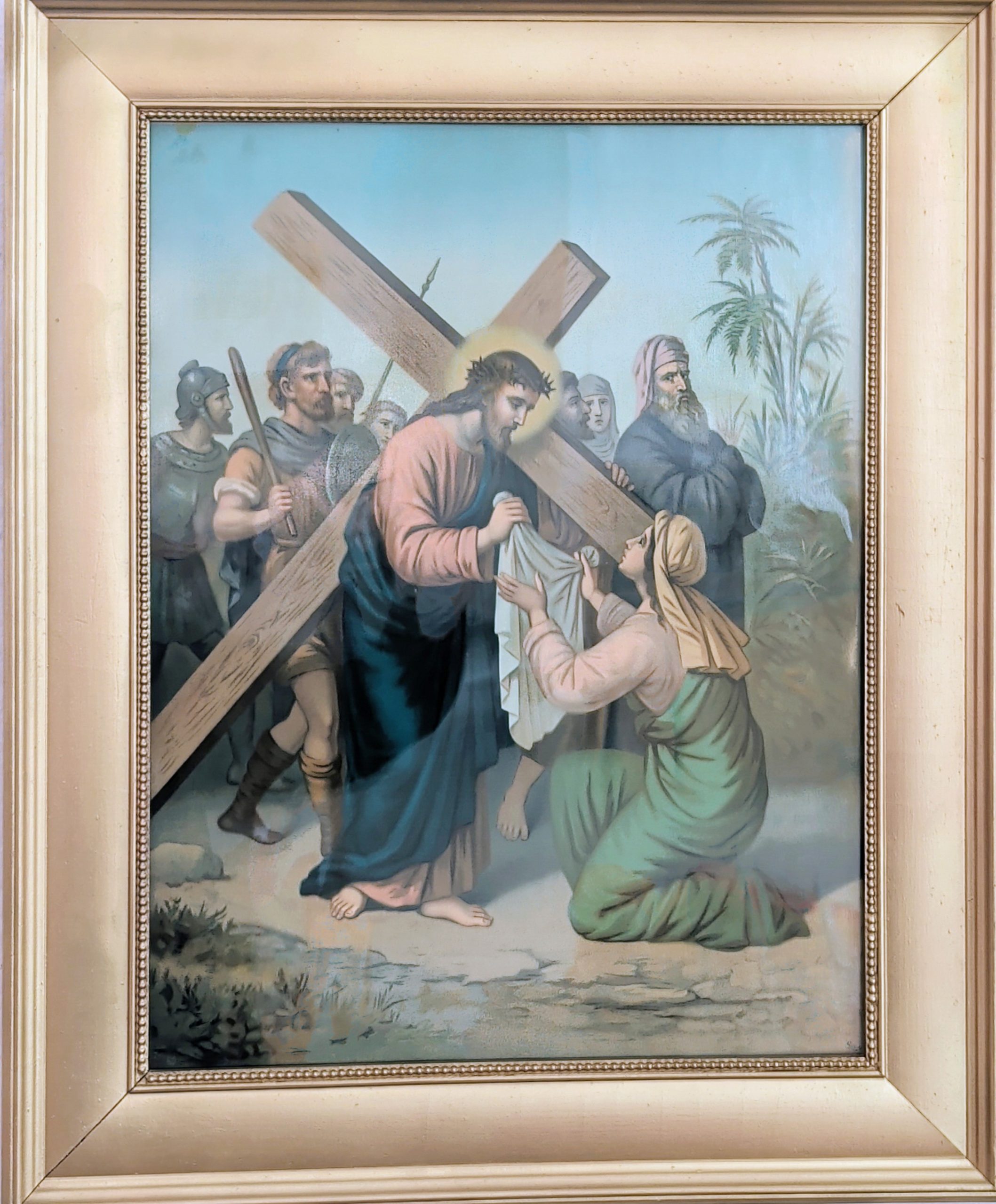
Also called Stations of the Cross, Via Crucis, and Via Dolorosa. These names are used to signify either a series of pictures or tableaux representing certain scenes in the Passion of Christ, each corresponding to a particular incident, or the special form of devotion connected with such representations. They are usually ranged at intervals around the walls of a church, though sometimes they are to be found in the open air, especially on roads leading to a church or a shrine. The erection and use of the Stations was not a wide spread practice before the seventeenth century; but they are now to be found in almost every church. Formerly, their numbers varied considerably in different places but fourteen are now prescribed by the Church. They are as follows
1. Jesus is condemned to death
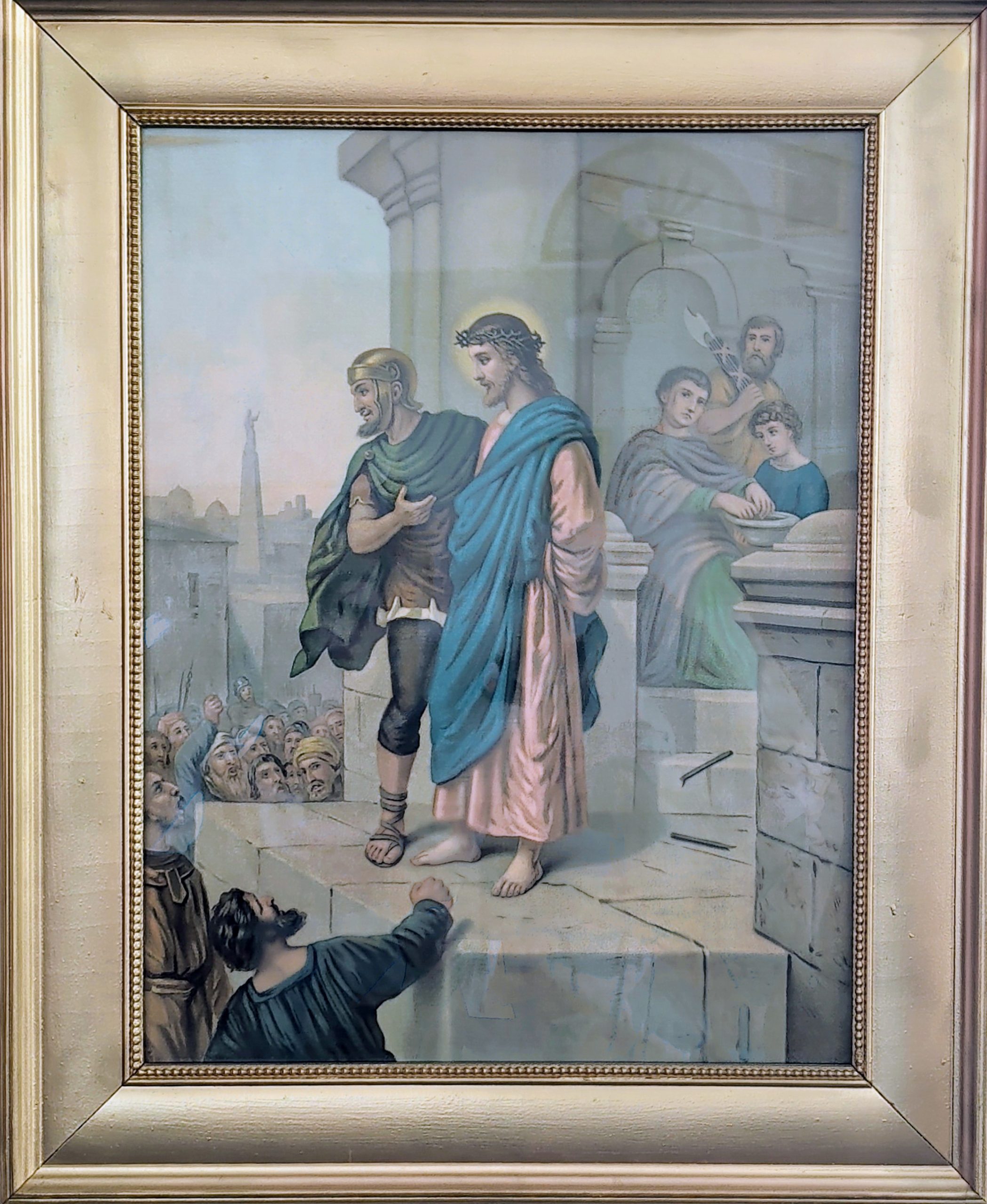
2. Jesus receives his cross
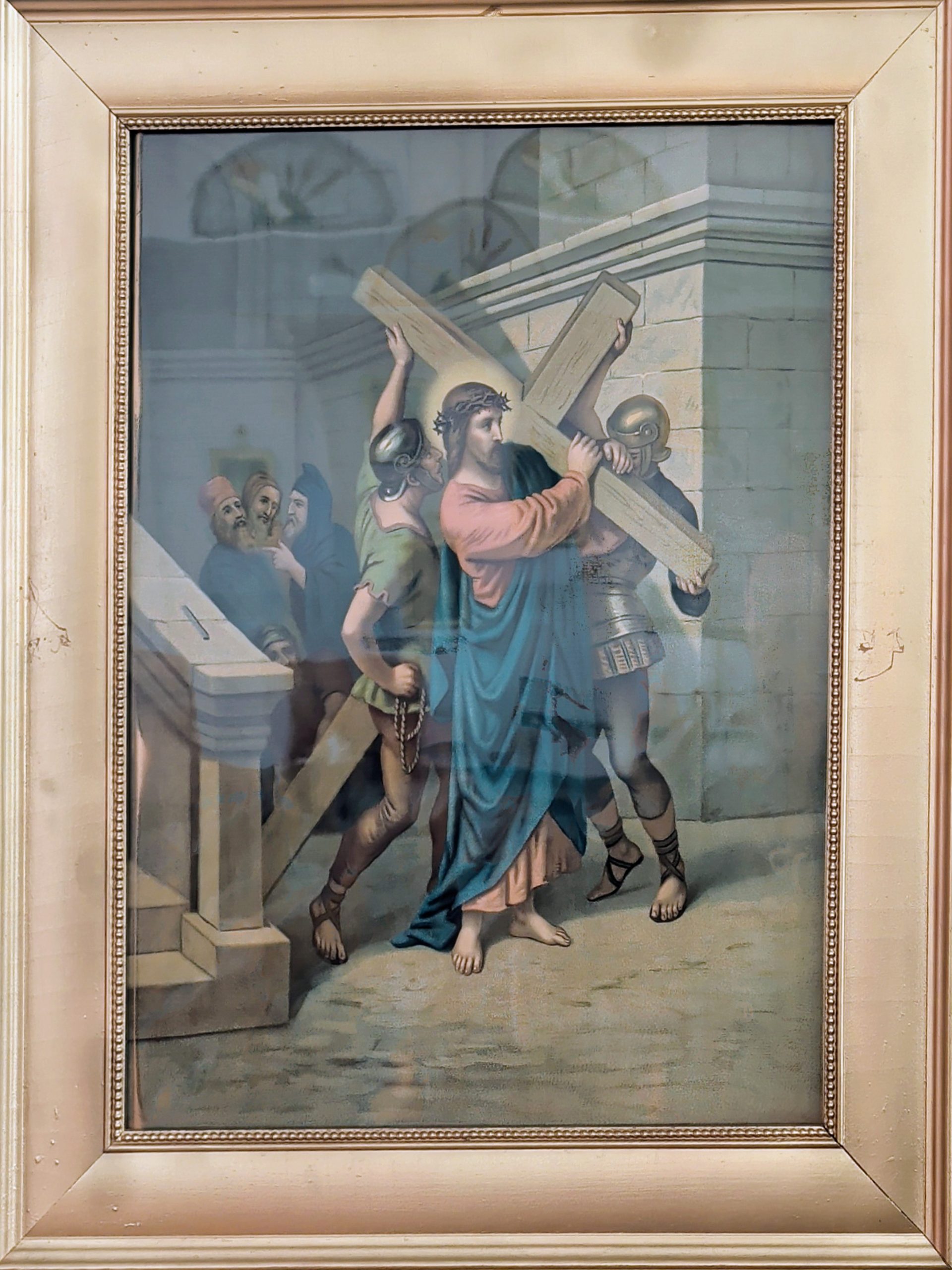
3. Jesus falls the first time
4. He meets his Mother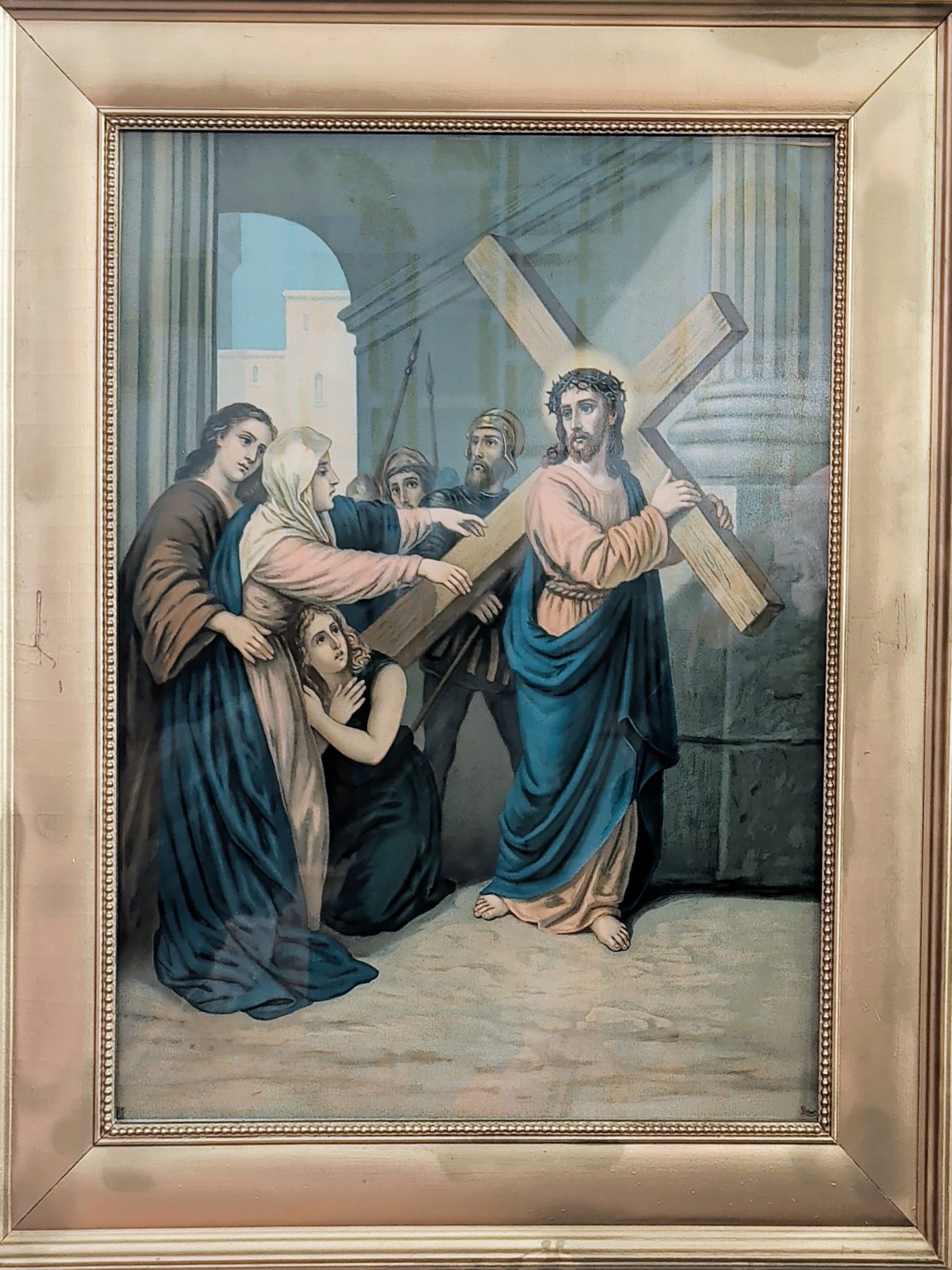
5. Simon of Cyrene helps our Lord carry the cross
6. Veronica wipes the face of Jesus
7. Jesus falls a second time
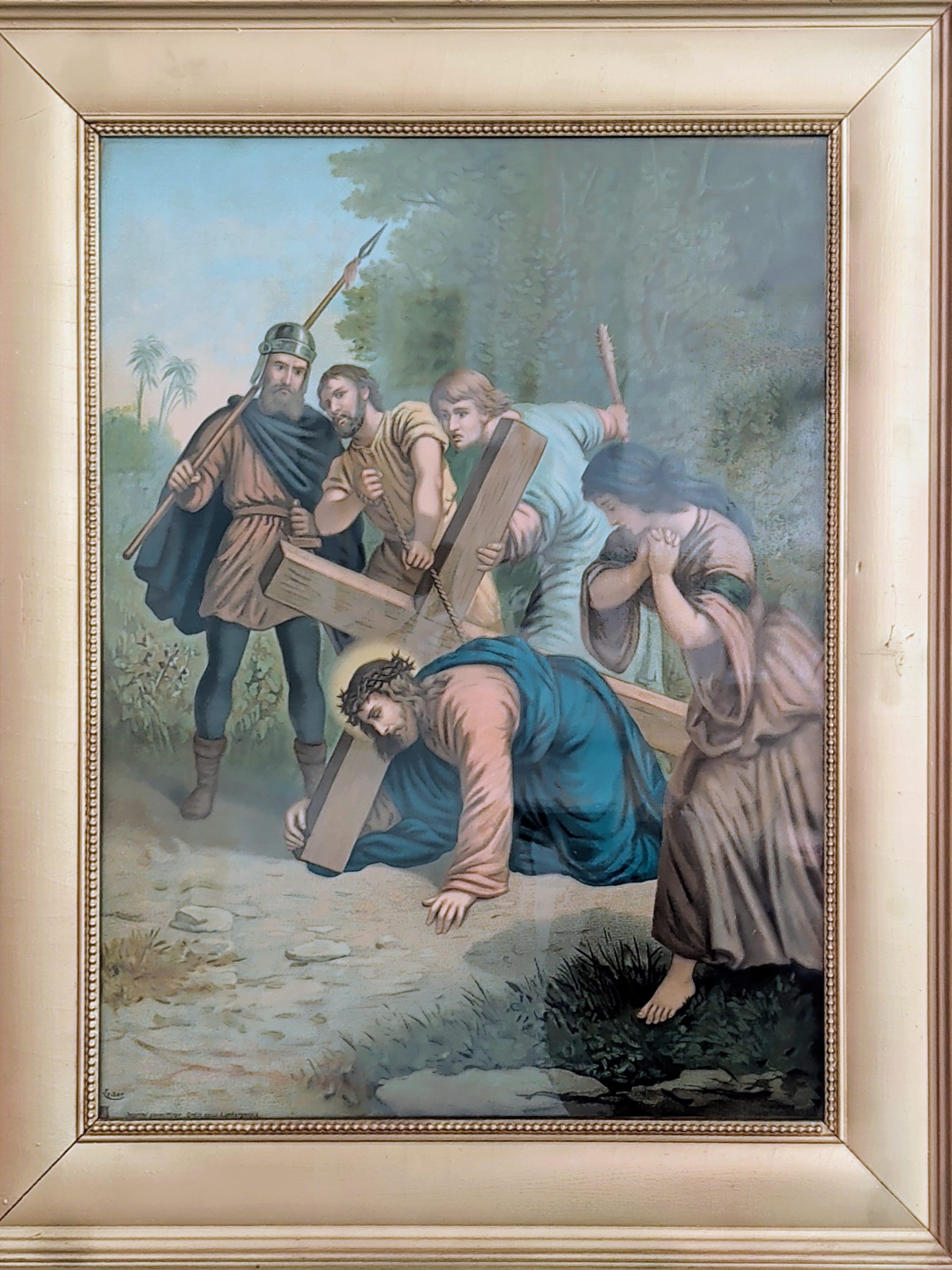
8. Jesus meets the women of Jerusalem;
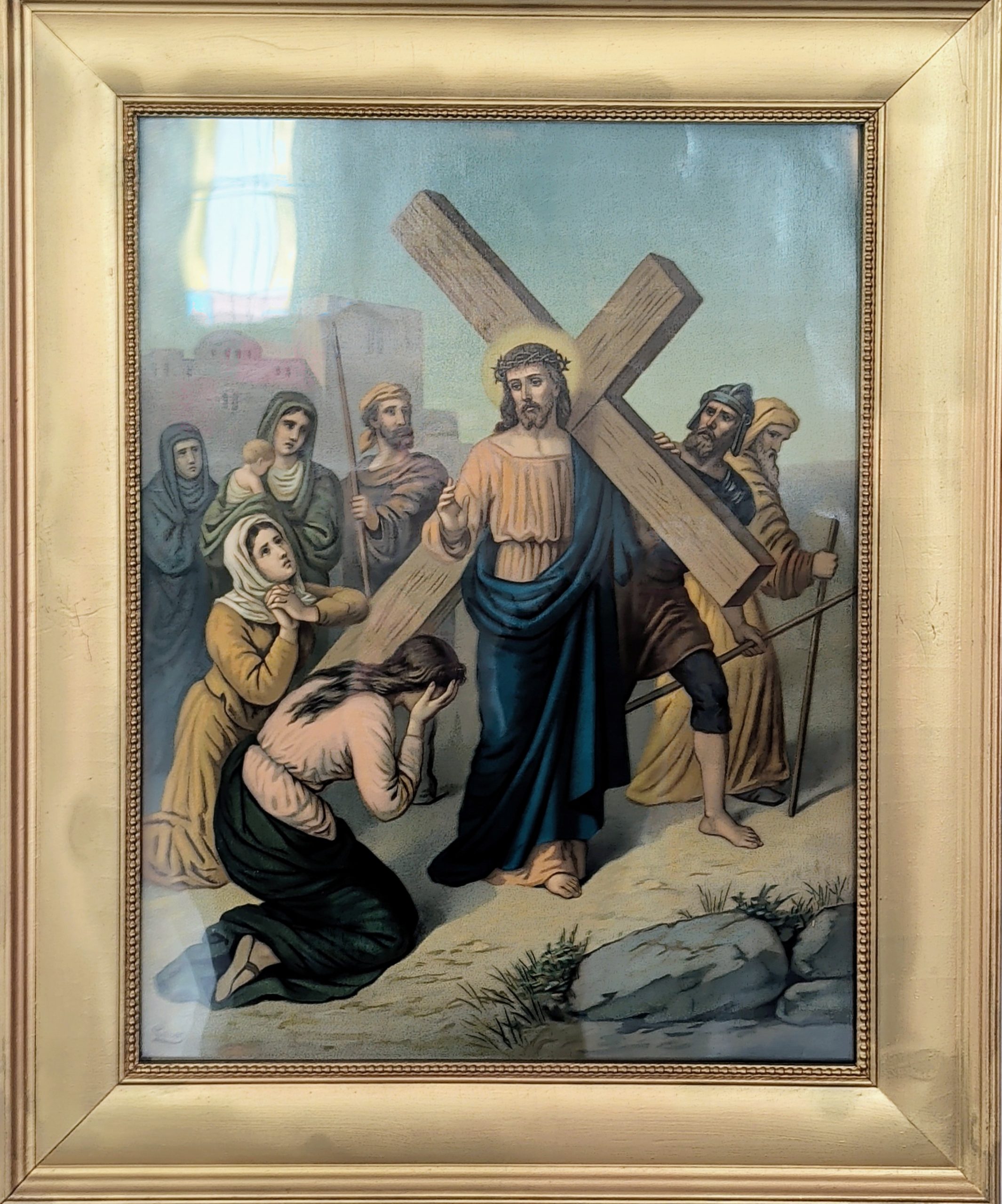
9. Jesus falls a third time
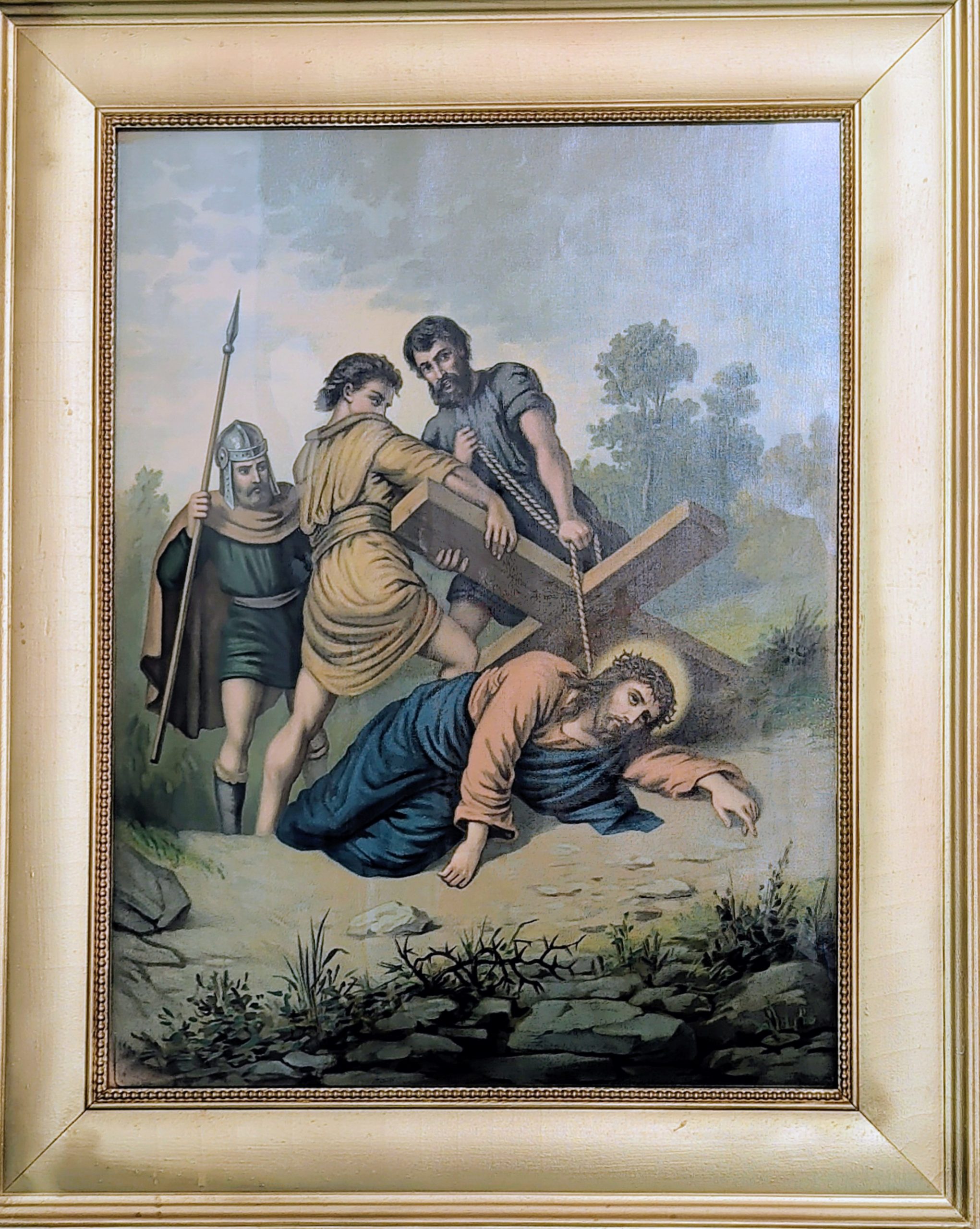
10. Jesus is stripped of his garments
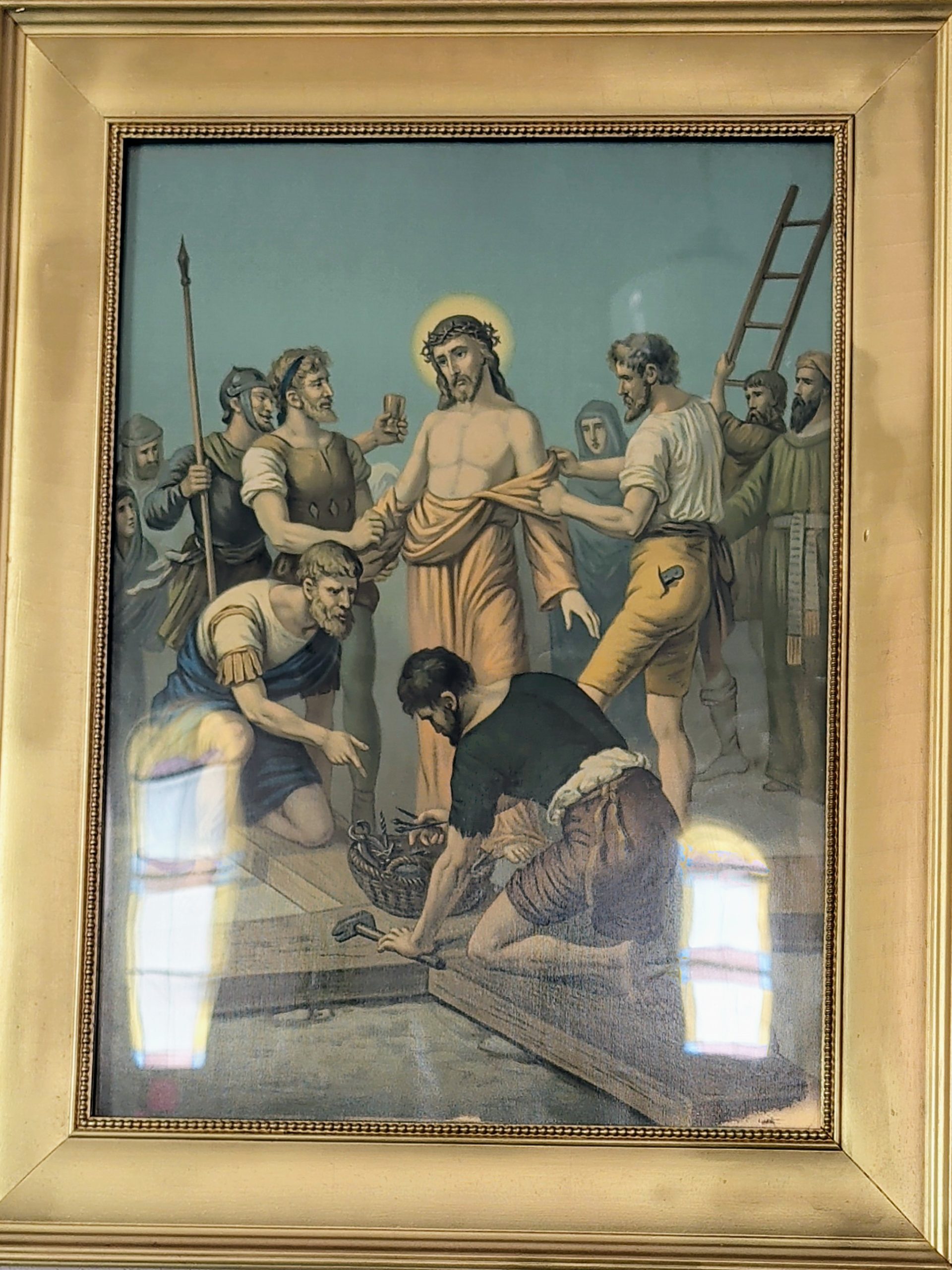
11. The crucifixion, Jesus is nailed to the cross
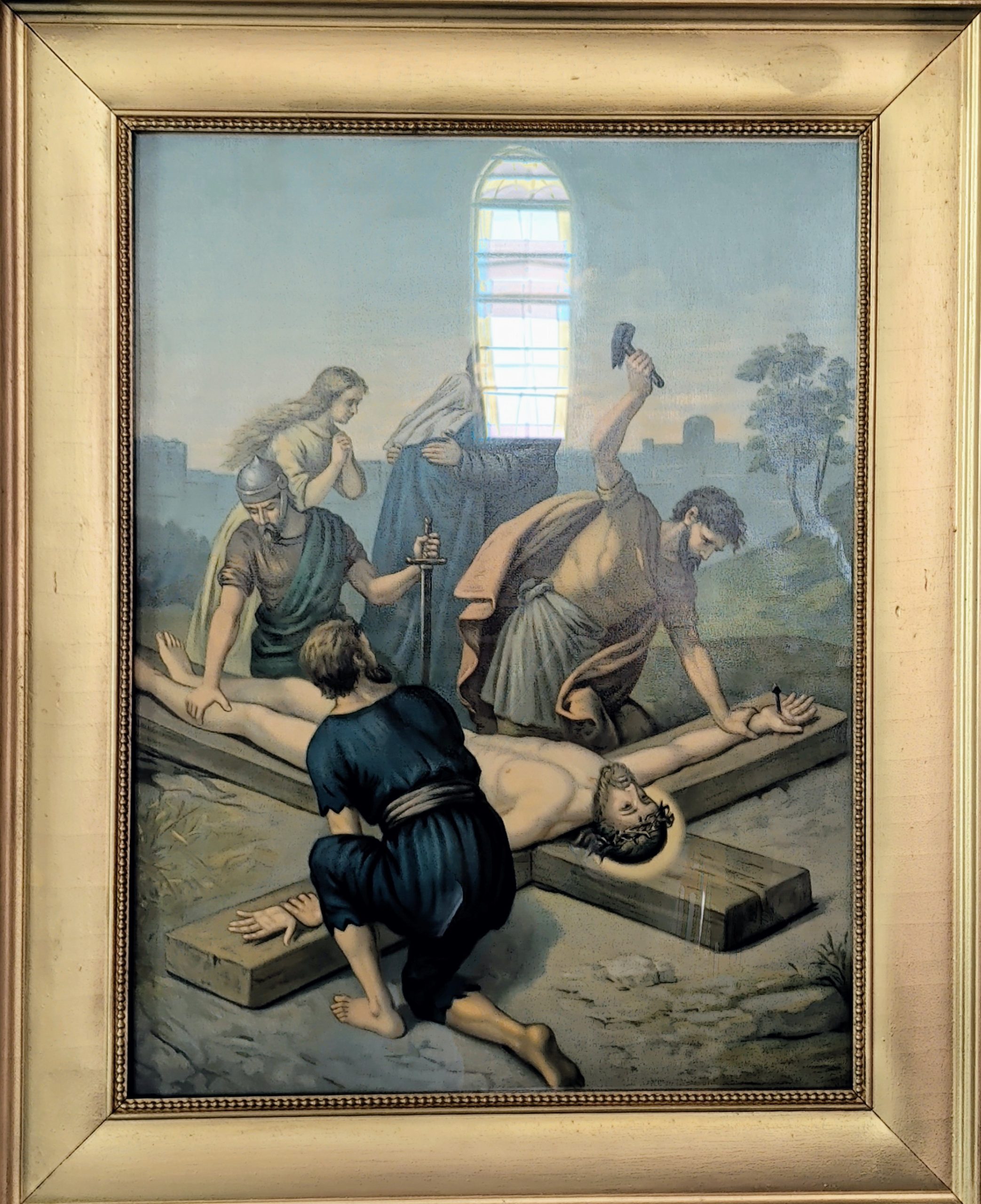
12. Jesus dies on the cross
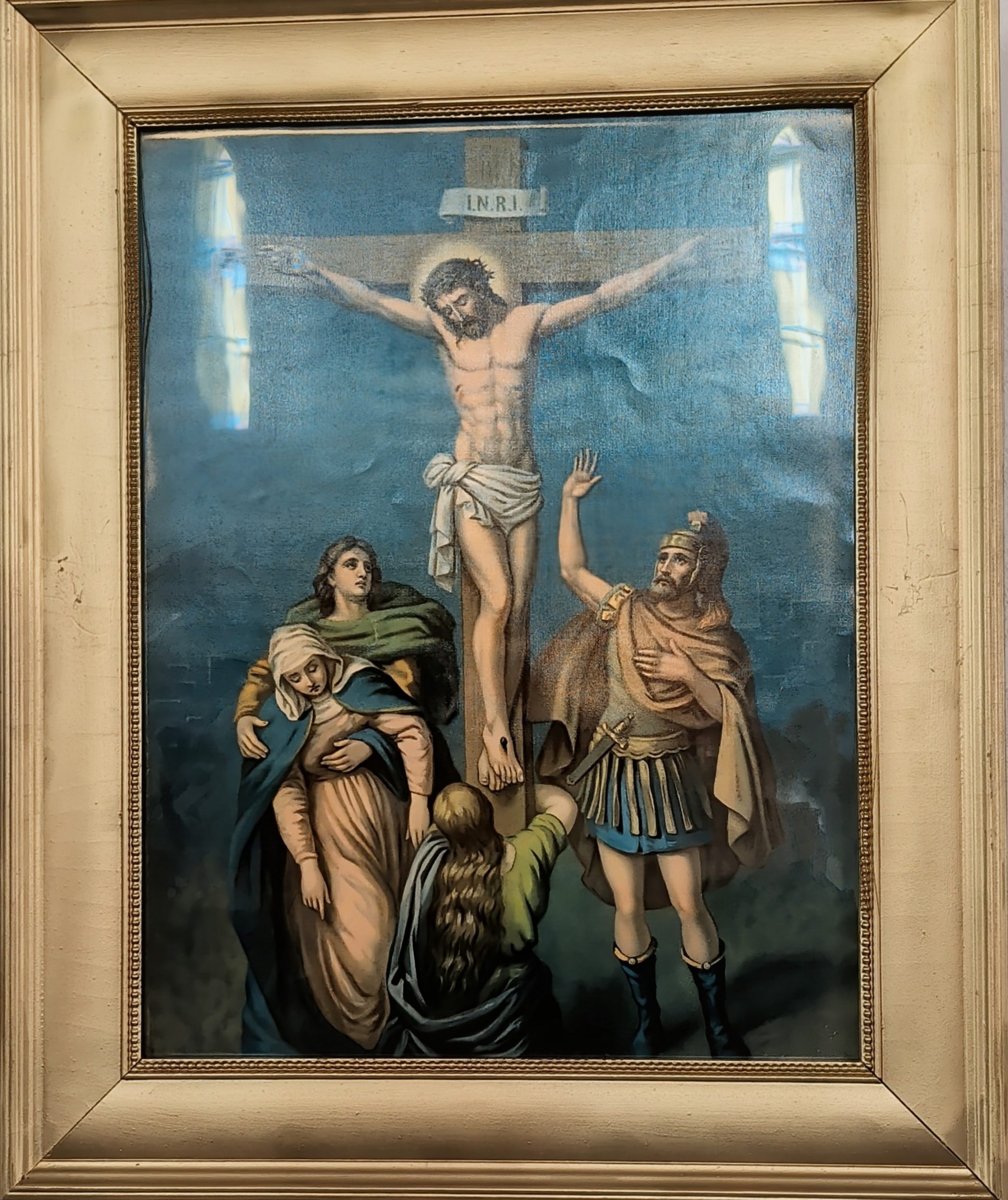
13. Jesus is taken down from the cross
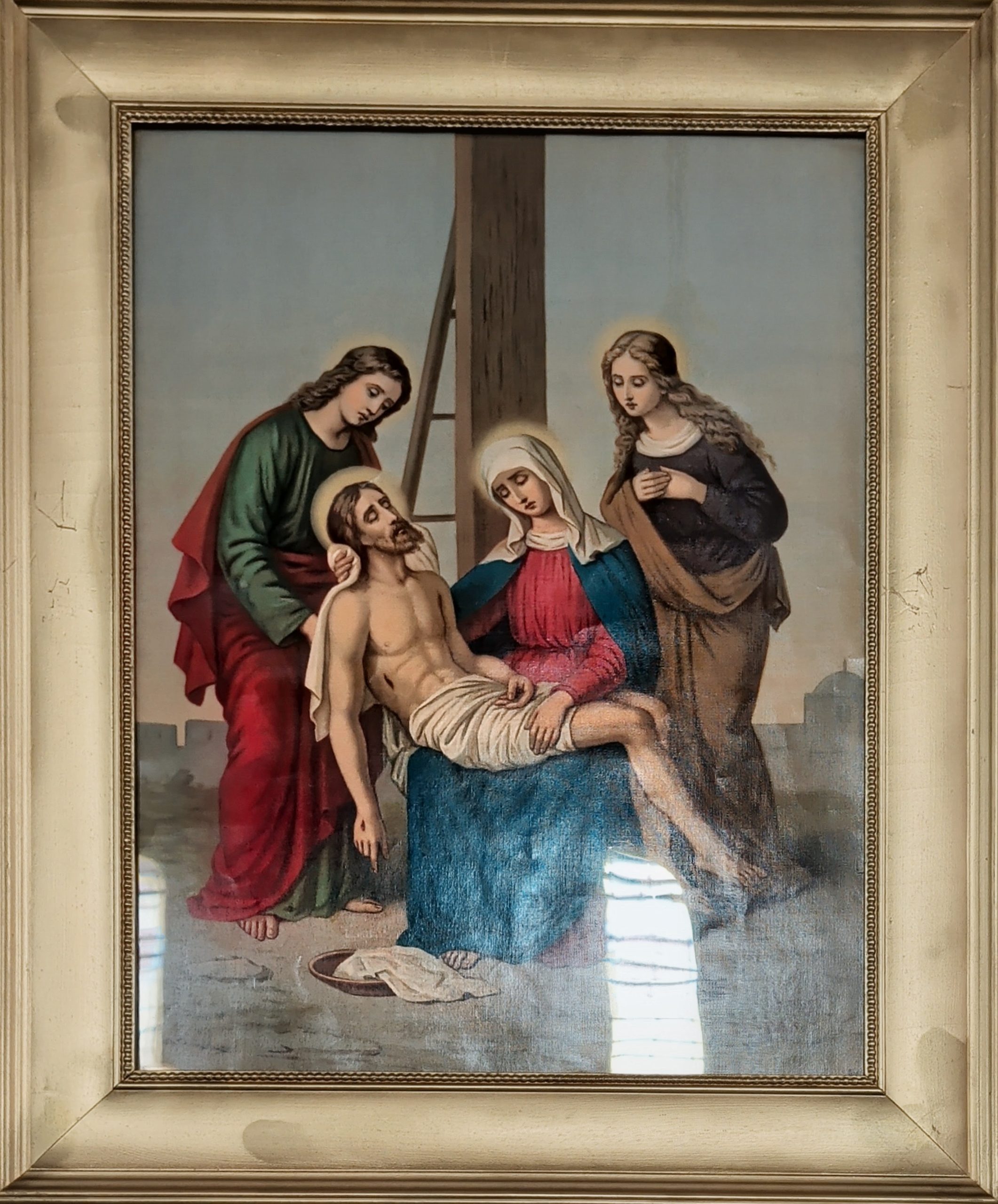
14. Jesus is laid in the tomb
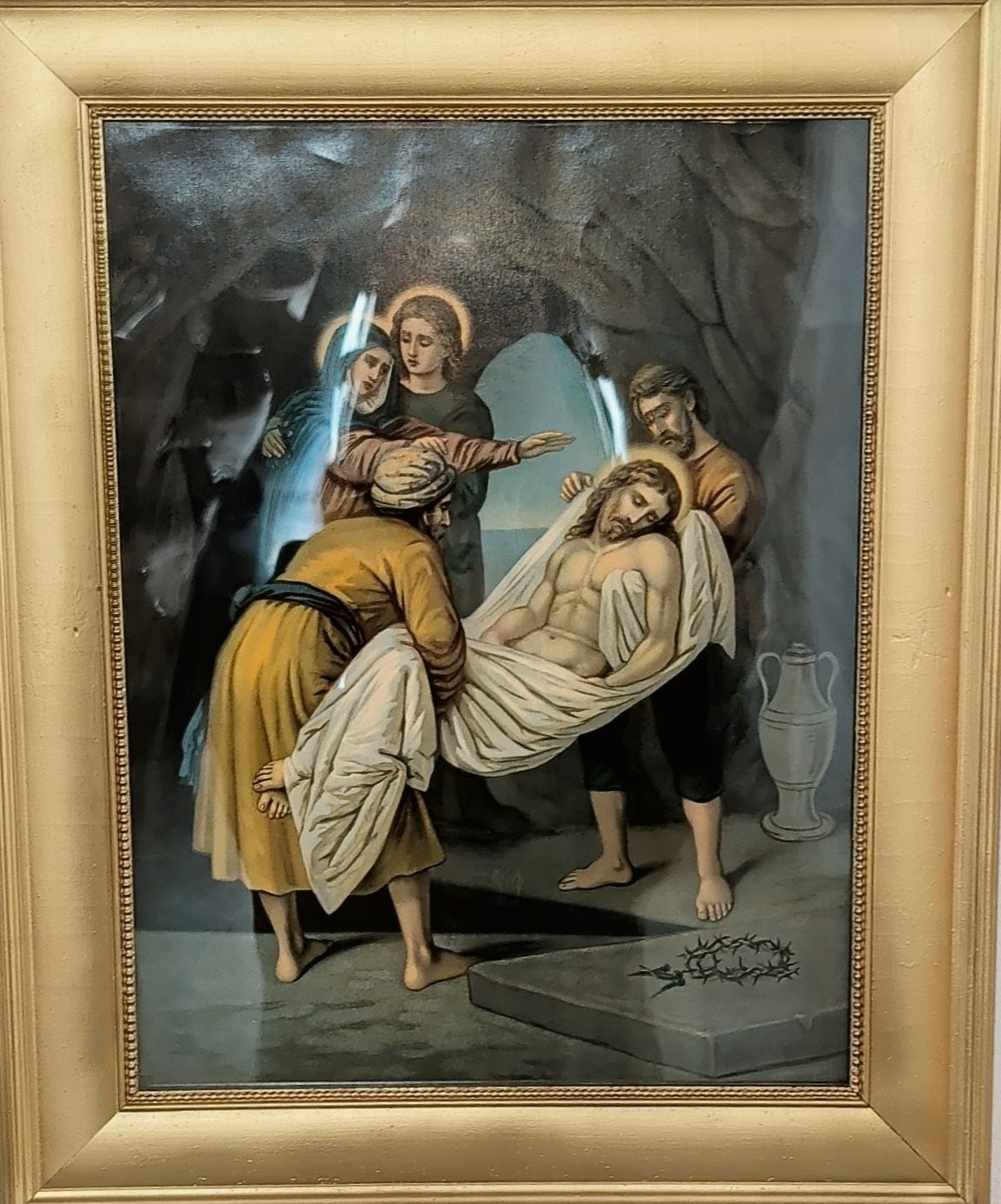
The object of the Stations is to help the faithful to make in spirit, as it were, a pilgrimage to the chief scenes of Christ’s sufferings and death, and this has become one of the most popular of Catholic devotions, especially in Lent. It may be safely asserted that there is no devotion more richly endowed with indulgences than the Way of the Cross, and none which enables us more literally to obey Christ’s injunction to take up our cross and follow Him. (From The Catholic Encyclopedia)
History of the St. Brieux Church
In 1914, the old log church, built in 1904, was found to be in a sad state of repair and it was determined that it was time to build a new church. Father Barbier, along with the board of trustees, canvassed all the parishioners and raised the sum of $1 000.00
Three acres of land were bought from Mr. A. Delorme at $50.00 an acre by Father Barbier who then donated the land to the parish. Mr. Con Dahmer, a local carpenter, was contracted to construct the new church. Construction by Mr. Dahmer and volunteer parishioners started on July 22nd, 1915 and by fall, the outside of the structure was completed. The hail storm of 1916 caused serious crop damage and postponed the completion of the inside of the church until later in 1917.
The bazaar in the winter or 1917-18 was very successful and provided an additional $1 200.00 to furnish the church with pews and a communion rail. Although the new church was already being used for masses, it wasn’t until July 27th, 1919, that Rev. Th. Schmidt, representing Bishop Pascal, attended to the blessing of the church. In 1919, Mr. L.C. Reinier donated a piece of land adjacent to the church, enabling the parishioners to build a new rectory. In the fall of 1921, a year after completion, Fr. Barbier reluctantly moved from his old hermitage one half mile west of town, to his modern quarters.
The community realized that with the growth in the population of St. Brieux and its rural area there was a need to enlarge the church. In 1951, under the direction of Father Rivard and parish council, Mr. E. Forgues of Prud’homme undertook and completed the task of adding two wings, a sanctuary and a sacristy to the existing church.
The church served the community very well until 1988 when the structural integrity of the church came into question while during a Sunday mass the floor appeared to drop a couple of inches. Engineers were brought in to assess the soundness of the building and its foundation and to determine what was needed to render it serviceable for future years. Their findings resulted in the shoring up of the foundation, propping up of the floor and extensive repairs to the roof.
In 1998 and 1999 Partners in the Harvest Campaign funds were made available for work on the church. Father Jim Kaptein commissioned a parish-wide survey to determine what the parishioners’ thoughts and feelings were with regard to carrying out renovations to the church and to determine to what extent they wanted to see changes made. An analysis of the survey resulted in a plan being drafted and approved by the parish community accommodating the needs identified in the survey. This plan called for an addition being built joining the pastoral center to the church.
This beautiful and functional new 2000 square foot addition we are enjoying today accommodates a sacristy, new washrooms, a storage room, a meeting/gathering room and increases the worship area of the church by 720 square feet. Barring any unforseen incidents, the church as it now stands should serve the community for another 50 years.
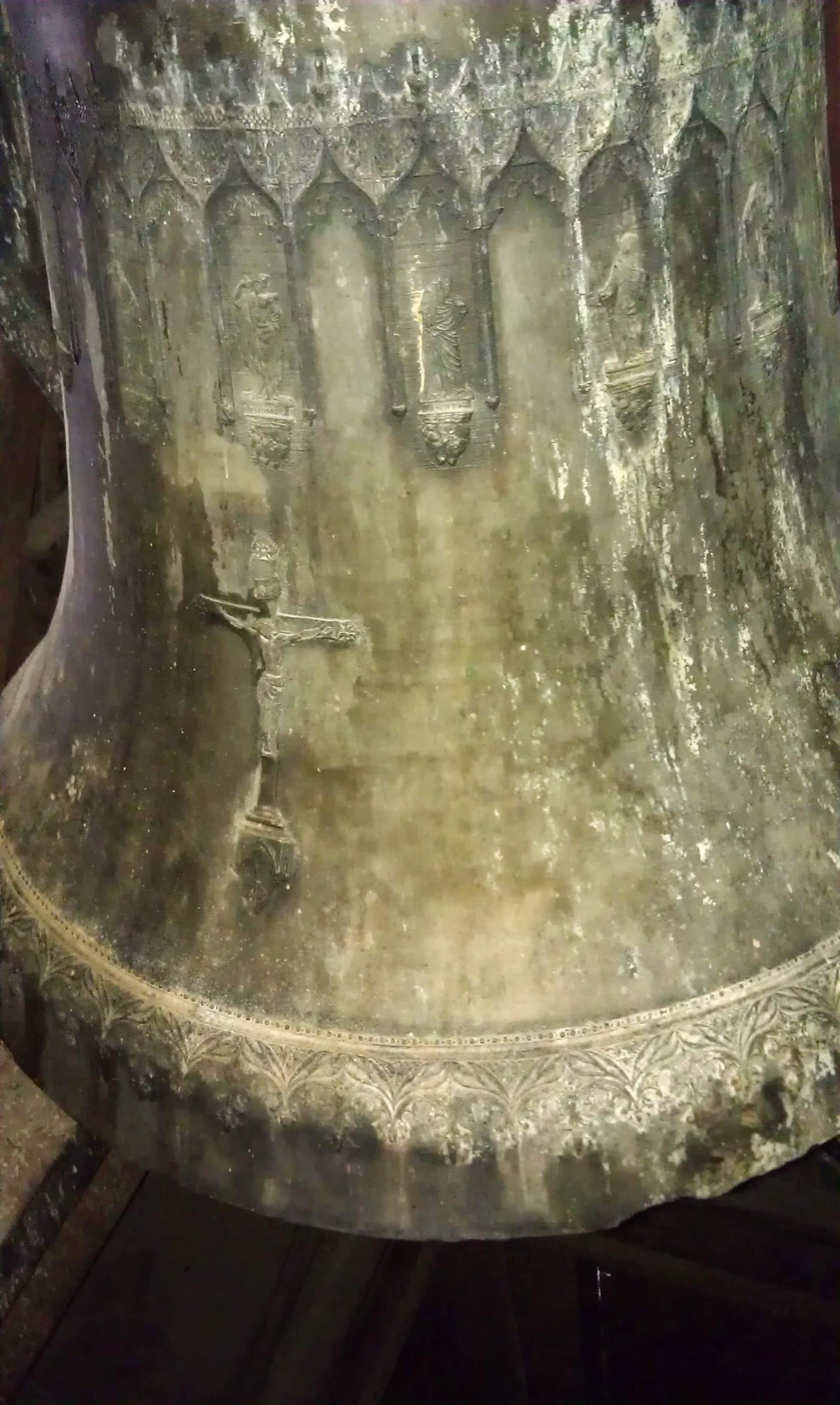
The following pictures are of the present bell in St. Brieux, the first is the front of the bell with “Jesus on the Cross” the second is the back of the bell with the “Virgin Mary.”